How to cut onions without crying (and what doesn’t work)
Why onions make you cry, the few methods that genuinely help, and the kitchen myths, from bread in your mouth to a candle by the board, that don't.
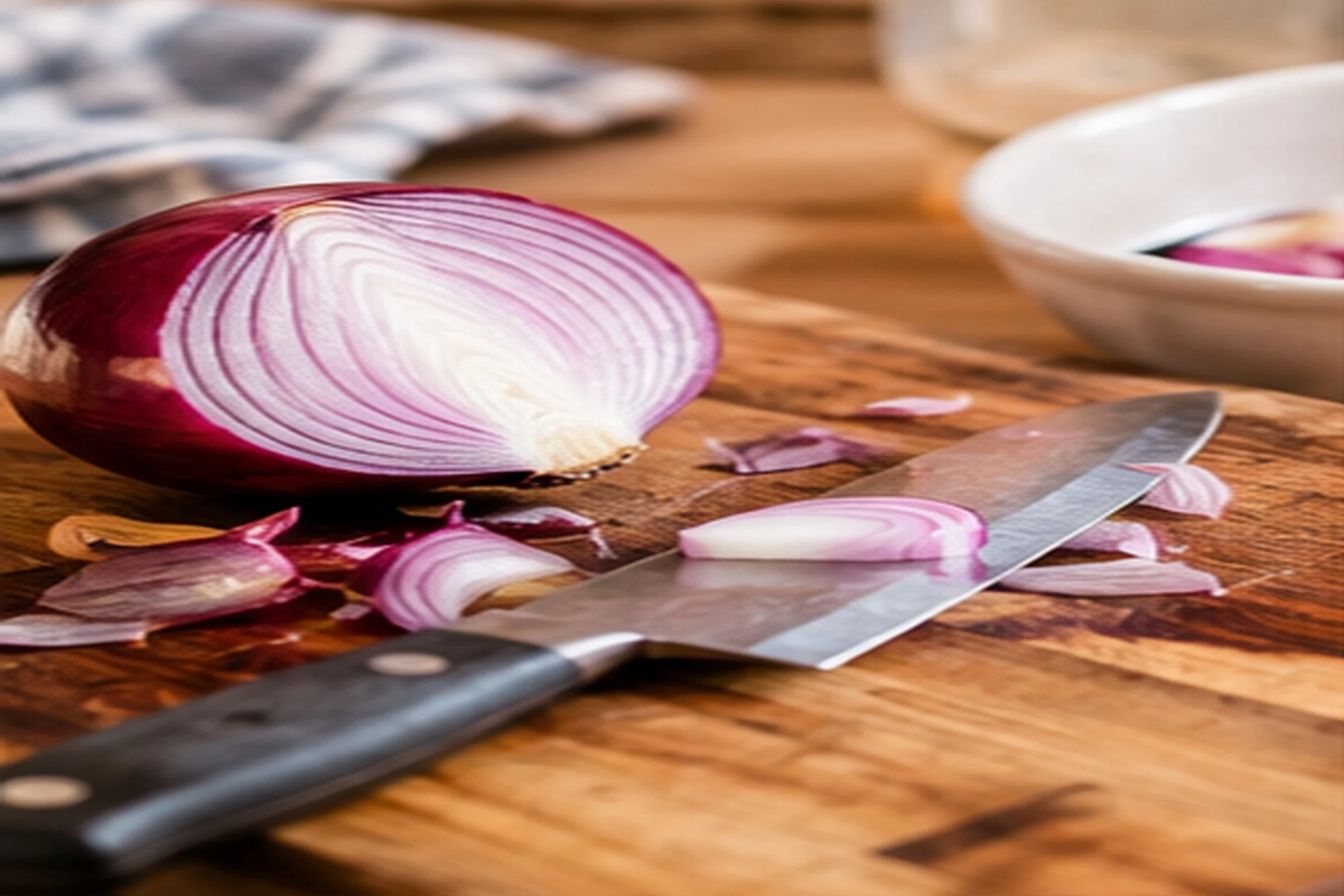
Everyone has a theory about how to cut onions without crying. Hold a match in your teeth. Chew gum. Put a slice of bread in your mouth. Light a candle next to the board. Most of these are kitchen folklore, passed on with total confidence and very little success. A few things genuinely help, and they all make sense once you know why onions make you cry in the first place.
Why onions make you cry
An intact onion is harmless to your eyes. The trouble starts when you break its cells. Cutting releases enzymes that turn sulphur compounds in the onion into a volatile gas called syn-propanethial-S-oxide, the onion’s chemical defence against being eaten. That gas drifts up from the board, reaches your eyes and irritates the nerve endings on their surface, and your eyes respond the only way they can: by producing tears to wash the irritant away.
Two things follow. The more cells you crush, the more gas you make. And the more of that gas reaches your eyes, the worse it gets. Every method that actually works does one of those two things: it makes less gas, or it keeps the gas away from your face.
What actually works
A sharp knife
This is the single most useful change, and the least glamorous. A sharp blade slices cleanly through the onion’s cells; a dull one crushes and tears them, releasing far more of the compounds that cause the problem. If cutting onions always makes you cry, the knife is the first thing to check. A sharp knife is also safer, because it goes where you aim it instead of skidding off the curved skin.
Chilling the onion first
Cold slows the chemical reaction and makes the gas less volatile, so less of it rises towards your face. Put the onion in the fridge for half an hour, or the freezer for ten to fifteen minutes, before you cut it. Do not leave it in the freezer much longer, or the texture suffers and it becomes slippery to handle. Some cooks simply store onions in the fridge if they cut a lot of them, though they keep their texture and flavour better in a cool, dark, dry cupboard.
Moving the air
The gas has to travel from the board to your eyes. Interrupt the journey. Cut next to an open window, under an extractor hood switched on, or with a small fan blowing gently across the board and away from you. This is one of the most effective methods, and one of the least used.
Keeping your face out of the cloud
Stand up straight rather than leaning over the board. Keep your head back and to one side. It sounds trivial, and it makes a noticeable difference, because the gas is most concentrated just above the cut onion.
Leaving the root on until last
The root end holds a high concentration of the compounds that cause irritation. The classic technique for dicing an onion keeps it intact: cut the onion in half through the root, peel it, make your horizontal and vertical cuts towards the root without cutting through it, then slice across. The root holds the layers together while you work, which makes dicing faster and neater, and you throw it away at the end without ever cutting into it.
Working quickly and clearing as you go
The longer cut onion sits on the board, the longer it keeps releasing gas. Once it is chopped, move it to the pan or into a covered bowl. Speed comes with a sharp knife and a good technique, and it is one of the main reasons professional cooks seem unaffected.
Goggles
They look ridiculous and they work, provided they seal properly around your eyes. Swimming goggles do the job. Ordinary glasses help a little but leave gaps at the sides. If you cook onions every day and nothing else helps, a cheap pair of goggles kept in a kitchen drawer is not an unreasonable solution.
Contact lenses
Many people who wear contact lenses find they cry less when cutting onions, since the lens covers part of the eye’s surface. That is not a reason to start wearing them, but it explains why some people insist they have never had a problem.
What doesn’t work (or barely does)
Bread, gum or a match in your mouth
The idea is that the bread or match absorbs the gas before it reaches your eyes. It does not have much opportunity to: the gas reaches your eyes directly from the board, not via your mouth. Any small benefit probably comes from the fact that you are breathing through your mouth and holding your head differently.
A candle beside the board
The theory is that the flame burns off the gas or draws it away. The effect, if any, is small, and an open flame next to a busy chopping board is a bad idea in its own right. Use a fan or an open window instead.
Cutting under running water or in a bowl of water
This does reduce the gas, because the compounds dissolve in water. But a wet, slippery onion under a running tap is awkward and unsafe to cut, and it washes away some of the flavour you wanted. As a last resort for someone very sensitive, briefly rinsing the halved onion can help; chopping it under the tap is not worth the risk to your fingers.
Vinegar on the board, salt, lemon, a spoon in your mouth
None of these has a plausible way of stopping a gas that travels through the air into your eyes. Be wary of any article that offers precise percentages for how much each trick reduces crying. Kitchen myths attract a lot of confident numbers.
Do some onions make you cry less?
Yes. Onions vary a great deal. Sweet and mild varieties tend to produce less of the irritating compound than strong yellow or brown cooking onions. Older onions that have been stored for a long time are often harsher. Shallots and spring onions (scallions) are generally gentler too. If you are cooking for flavour rather than sting, choosing a milder onion helps before you even pick up the knife.
The short version
Sharpen your knife. Chill the onion. Cut it with the root on, standing up straight, in moving air. Get the chopped onion off the board quickly. That combination will stop most people crying, and none of it requires a match, a slice of bread or a candle.
Onions are also one of the most forgiving ingredients to store and use up, which matters if you are cooking for one without wasting food. Keep whole onions somewhere cool, dark and airy, away from potatoes, and keep a cut half wrapped in the fridge for a day or two. Like fresh herbs, they last much longer when they are stored the right way.