Is it rude to leave a group chat?
Leaving a group chat is ordinary, and a muted chat you never read is the stranger choice. When to go, when to think twice, and what to say.
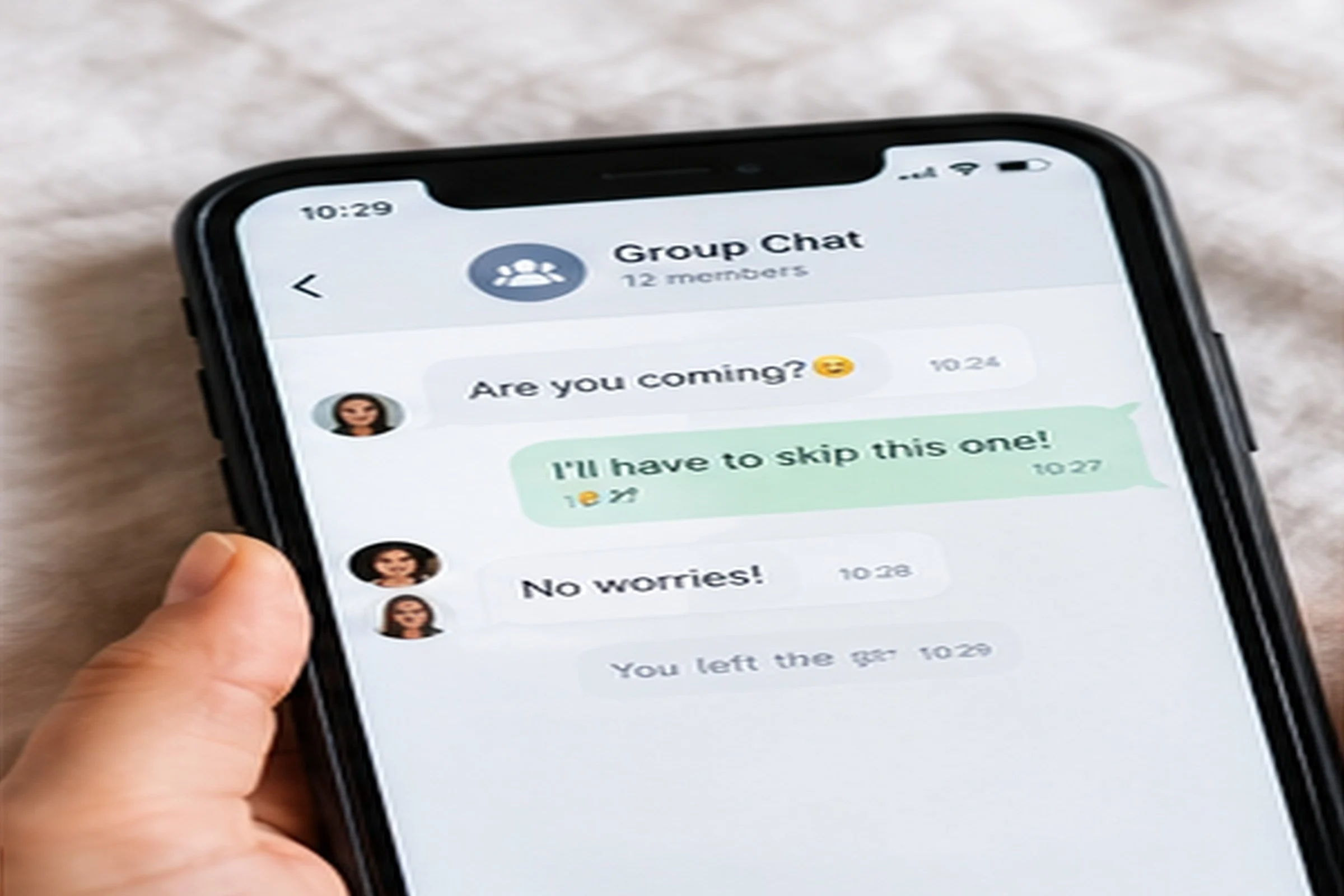
Is it rude to leave a group chat? No. Leaving a group chat is one of the most ordinary things a person can do on a phone, and the fact that it can feel like slamming a door says more about how we treat group chats than about the person leaving. You can leave a chat politely in one line. What is genuinely odd is the alternative most people choose: staying in a conversation for years with notifications muted, pretending to be part of something you stopped reading long ago.
Why leaving feels like a statement
Group chats have a strange status. They are informal, but they come with an unspoken membership. When someone leaves, most apps announce it to everyone: a small grey line saying who has gone. Nobody hears the reason, only the departure, and people fill the silence with the worst interpretation. Did we say something? Is she annoyed? Is this about the party?
That reaction is human, but it rests on a confusion. A group chat is a tool, not a friendship. Leaving one is closer to stepping out of a noisy room than to ending a relationship. The friends are still there; the conversation is simply happening without you.
When leaving is completely fine
- The chat had a purpose and the purpose is over. The wedding has happened, the trip is booked, the gift has been bought, the event is done. Nobody needs a forty-person thread about a pre-wedding weekend from three years ago.
- It is huge. Once a chat has dozens of members, the polite assumption is that people come and go. Nobody is tracking attendance.
- You were added without being asked. A neighbourhood group, a work social chat, a school parents’ group you were dropped into: leaving is a reasonable response to an invitation you never accepted.
- The volume is unmanageable. Two hundred messages a day about things you do not care about is a cost, and you are allowed to stop paying it.
- The tone has turned. If a chat has become a place for gossip, constant complaint or comments you would rather not be associated with, leaving is often the cleanest way to stop taking part, and nobody sensible will call it an overreaction.
When to think twice
There are a few situations where leaving needs more care.
- A small chat of close friends. With three or four people, leaving is noticed and felt. If something is wrong, say so to the people involved rather than letting a grey line do it for you.
- A chat that carries practical information you need. Work rotas, family logistics, a shared house: leaving may simply mean someone else has to forward everything to you.
- Straight after a disagreement. Leaving mid-argument reads as a dramatic exit even when you only wanted quiet. If you need distance, mute it and decide later.
In those cases muting is a perfectly good choice. But muting is a pause, not a permanent home. A chat you have muted for a year is a chat you have already left; the only question is whether you admit it.
How to leave a group chat politely
The polite exit is short. One line, warm, with no long explanation and no apology for existing. Some examples you could adapt:
- “I’m going to duck out of this one now the trip is sorted. Thanks for organising, everyone!”
- “Leaving the chat to cut down my notifications, but nothing’s wrong. Message me directly any time.”
- “Bowing out now the wedding’s over. It was lovely, and so was everyone in here.”
- “I’m trying to spend less time on my phone, so I’m leaving a few big groups. See you all soon.”
Then leave. Do not wait for replies, do not explain further, and do not reappear to clarify if someone sends a sad face. Your message has already done the job: it tells people you are not upset and that the door is open for direct contact.
You do not owe a reason in a large or practical group. In a small group of friends, a reason helps people understand that the exit is about the chat, not them.
What not to do
- Do not leave and rejoin repeatedly. It is more noticeable than leaving once.
- Do not post a long goodbye that invites a dozen replies, each of which you will now be notified about.
- Do not leave a group as a way of making a point to one person in it. If you have a problem with someone, deal with it directly.
- Do not take screenshots on your way out. Whatever was said in the chat stays there.
If someone leaves a chat you are in
Let them go. Do not message them to ask what happened, or speculate in the chat about why. Most people leave group chats for boring reasons: their phone is full, the notifications were relentless, they no longer needed to be there. If the person matters to you, send them a direct message about something else entirely. That is how friendships carry on outside a group.
The bigger point
Group chats are useful, and many of them are lovely. But they have also become a place where social obligation quietly accumulates. We answer messages we do not care about, we stay in groups out of politeness, and we treat silence as hostility. It is the same reflex that makes people ignore invitations rather than decline them, or stay at parties long after they wanted to go home, when slipping out quietly would have been kinder to everyone.
So leave the chat. Say a short, kind sentence on your way out. Keep the friendships that matter through the channels that matter: direct messages, phone calls, actual meetings. Friendships rarely end because someone left a group chat. They end, if they end, the way friendships often do: slowly, for lack of attention elsewhere.