How to change the way you eat without teaching your children to diet
Children notice what is on your plate. They take in far more of what you say about it.
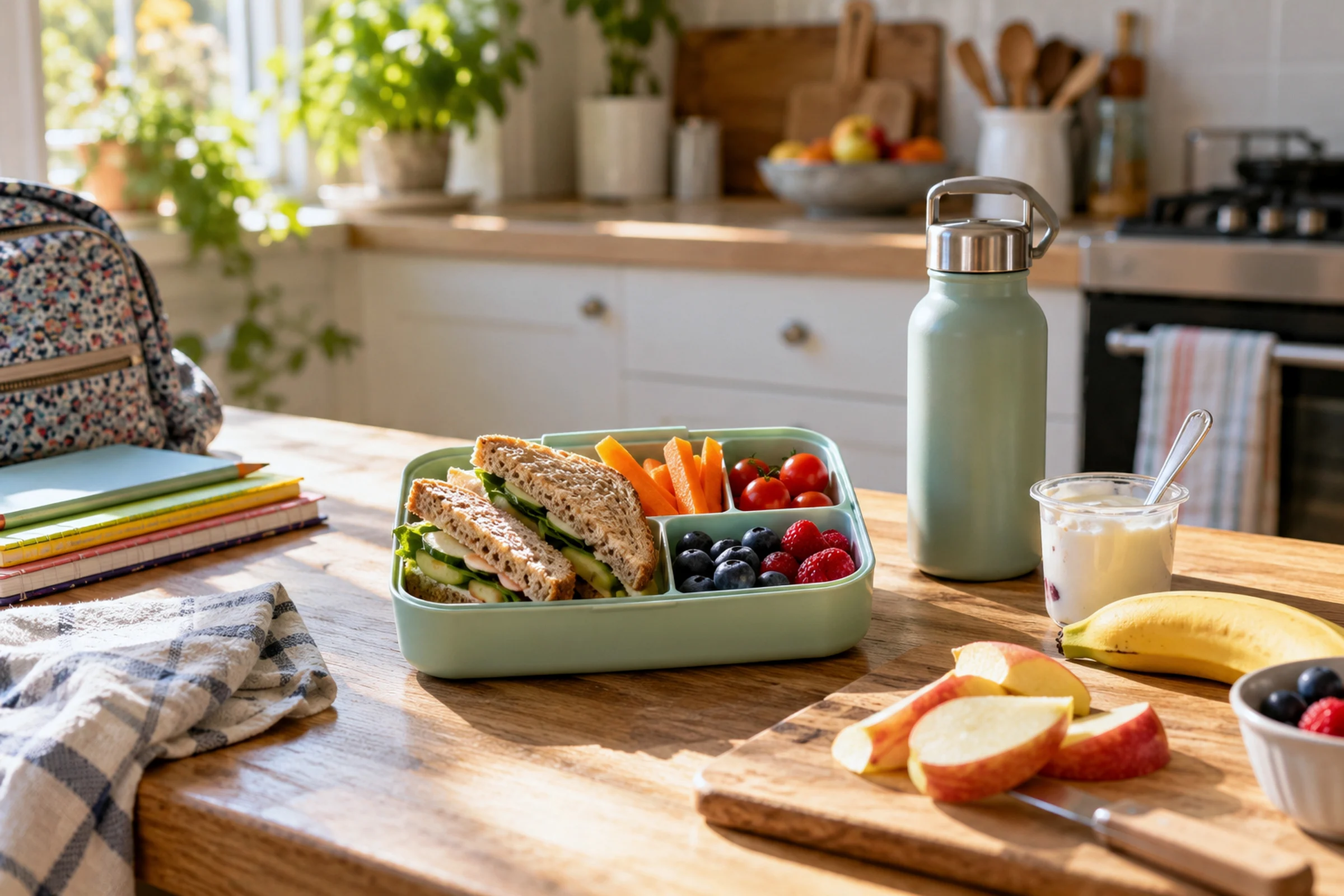
Plenty of parents change the way they eat for reasons that are nobody else’s business: a diagnosis, advice from a doctor, a new medication, wanting more energy, wanting to lose weight. This is not a piece about whether you should. It is about the people at the table who are watching you do it, and how to look after your own health without handing them a habit you would not choose for them.
What the research says children pick up
Children notice far more than adults tend to assume, and they notice early.
In a study of 197 five-year-old girls in the United States, published in 2000, researchers asked the girls what dieting was and what people did when they dieted. Depending on the question, between a third and two-thirds of them already had ideas about dieting. Girls whose mothers reported current or recent dieting were more than twice as likely to have those ideas.
Older children show the same pattern more sharply. In a 2010 study of adolescent girls in the United States, led by Dianne Neumark-Sztainer, 45% said their mothers had encouraged them to diet. Mothers’ dieting was associated with daughters using unhealthy and extreme ways of trying to control their weight, and parents talking about weight, including their own, was associated with a range of disordered eating behaviours. The researchers noted that in no case were family weight talk or dieting linked with better outcomes for the girls.
Conversations matter as well as example. A 2013 study in JAMA Pediatrics, led by Jerica Berge, found that teenagers whose parents talked to them about weight and size were more likely to diet, to use unhealthy weight-control behaviours and to binge eat. Among teenagers with higher weights, those whose mothers talked only about eating well, without mentioning size, were less likely to diet or use unhealthy weight-control behaviours.
Two cautions. These studies show associations, not proof that one thing caused the other. And most of this research looked at girls and their mothers, because that is where researchers looked; it is not evidence that boys and fathers are left out of it.
Do I need to hide what I am doing?
No. Secrecy makes food more mysterious and more charged, not less, and children are usually better at spotting a hidden rule than a stated one. What helps is a short, true explanation at their level, framed around health and what your body needs rather than around size.
For a younger child: “My doctor and I are working on keeping my blood sugar steady, so I’m eating a bit differently for a while.” Or simply: “This is what my body needs at the moment.” For an older child who asks directly, you can be more specific, still without turning your body into the subject of the conversation.
What to leave out is the part about being too big, needing to be smaller, or hating how you look. That part is not information they need, and it is the part most likely to stay with them.
The talk matters more than the plate
A child will see that you have a different lunch. What they are more likely to absorb is the language around it. Listen for it in yourself:
- “I’ve been so bad today.”
- “I can’t have that.”
- “I’ll have to earn this later.”
- “I’m being good this week.”
- “I look huge in this.”
Each one attaches a moral or a verdict to food or to a body. Children learn from these sentences that eating is something you can fail at, and that a body is something to be judged. Nina Noir has written before about how food is not a moral test; for children, the moral language is often the first lesson in treating it as one.
Swap in neutral, factual language. “I’m having soup today.” “I’m not hungry for pudding, but you go ahead.” “That was lovely.” It sounds almost too plain to matter, which is the point.
What about meals?
Where you can, keep one family meal and eat it together, even if what is on your plate is a little different. If you are eating something separate, do not narrate it. Serve your child the ordinary meal and let them decide how much of it to eat, without comments on portion size or on what they have chosen.
Avoid labelling foods as junk, clean, sinful or treats that must be deserved. Talk instead, if you talk about food at all, about what it is like: warm, crunchy, filling, good before football.
When other people bring it up
Some of the hardest moments come from outside: a relative who asks at the table how the diet is going, or congratulates you on what you have lost with your children listening. You are entitled to close it down. “We don’t really talk about weight at home” is enough. The same instinct that makes people congratulate weight loss before they know why will send it straight into your children’s hearing, and they are listening closely to what the adults around them praise.
If that relative has form, the conversation with them is worth having in advance and in private. Families are often the first place children learn how bodies are talked about, and the guidance on what to say when someone comments on your daughter’s weight applies just as well when the comment is about yours.
What if they already seem to have picked it up?
If a child starts calling themselves fat, asking to go on a diet, or refusing foods they used to enjoy, stay calm and curious. Ask where they heard it rather than rushing to reassure them about their size, because “you’re not fat” quietly agrees that being fat would be a problem. Something like “Bodies come in lots of shapes and sizes, and yours is busy growing” keeps the conversation open without turning it into a verdict.
Most of the time a passing remark is just that. Sometimes it is more. The usual medical advice, if you are worried that someone has an eating disorder, is to tell them gently that you are worried about them and encourage them to see a doctor. With a child, that usually means making the appointment yourself and going with them. Eating disorder charities in many countries also support parents and carers; in the UK, for example, Beat runs a service for them.
You are allowed to look after your own health, and your children are better off with a parent who does. What they learn from watching you depends much less on what is on your plate than on what you say about it, and about yourself, while they are listening.
Sources
- Abramovitz BA, Birch LL. Five-year-old girls’ ideas about dieting are predicted by their mothers’ dieting. Journal of the American Dietetic Association, 2000.
- Neumark-Sztainer D, Bauer KW, Friend S, et al. Family weight talk and dieting: how much do they matter for body dissatisfaction and disordered eating behaviors in adolescent girls? Journal of Adolescent Health, 2010.
- Berge JM, MacLehose R, Loth KA, et al. Parent conversations about healthful eating and weight: associations with adolescent disordered eating behaviors. JAMA Pediatrics, 2013.
- NHS (UK). Eating disorders: overview.
- Beat (UK). Support for carers.