Food is not a moral test
We have built a vocabulary in which lunch can make you a good or bad person. On what that language does, and what it is for.
Listen to how people talk about food for one day and count the moral words.
Good. Bad. Naughty. Sinful. Guilty. Clean. Being good this week. Deserved it. Earned it. Working it off. Cheating — which is my least favourite, because it implies a contract, and I have never been able to establish with whom.
None of these describe food. They describe a person’s standing.
What the language is doing
It converts a meal into a verdict. If a salad is virtuous, then eating it makes you virtuous, and eating the other thing makes you the other thing.
Which means every day contains a dozen small opportunities to fail at being a person. Not to eat something you did not want, or that did not agree with you — to fail, in a way that attaches to your character rather than your afternoon.
Nobody can sustain that. What they can do is get very good at hiding it, which is what most of us did.
Nothing on a plate has ever been able to tell you what kind of person you are.
The secret eating
This is the part that follows and it is rarely discussed with much honesty.
When eating becomes a performance judged by others, a great many people separate their eating into public and private. The public version is edited. The private version is where the actual food happens, quickly, often standing up, and with a running commentary of shame that has nothing to do with hunger.
The moral framing did not make anyone healthier. It made them secretive. Those are not the same outcome, and they get confused constantly by people who think the shame is working.
Where the language comes from
It is not accidental and it is not ancient. Much of this vocabulary was built deliberately, by people selling something, over a fairly short period.
A product described as guilt-free requires guilt to exist first. A treat you have earned requires a ledger. An indulgence requires a baseline of restraint against which it registers as a lapse. The words do not describe a pre-existing moral landscape; they construct one, because a customer who feels she has transgressed is a customer with a problem you can solve.
Once I noticed how much of it arrived through packaging and advertising rather than through anything I had thought, it lost some of its authority. It is difficult to feel morally compromised by a biscuit when you can see the marketing department behind the feeling.
What it does to children
The part I find hardest to write about calmly is how early this is installed.
Children learn the moral vocabulary of food long before they can evaluate it. They hear which foods are naughty. They watch adults narrate their own meals as confessions. They notice who is praised for restraint at a family table, and they are extremely good at inferring rules from tone.
I do not think most of the adults doing this intend to teach anything. It is simply the water. But a child who learns that eating is a moral performance has been handed something that will take decades to put down, and quite often will not be put down at all.
If there is one place to interrupt this, it is there — in what gets said out loud at a table where a child is listening.
This is not “eat whatever, it does not matter”
I want to be careful, because this is where the argument usually gets flattened.
What you eat has effects. Of course it does. Food affects energy, digestion, sleep, how you feel at four in the afternoon, and — with a clinician who knows your history — the management of specific conditions. I am not going to pretend otherwise, and I would not trust anyone who did.
The claim is narrower and, I think, harder to argue with: none of those effects are moral. A food can be more or less useful to you, on a particular day, for a particular purpose. It cannot make you a better or worse human being, and treating it as though it can is both inaccurate and — going by results — spectacularly counterproductive.
What I changed
Mostly the language, and mostly by deliberate substitution.
Not “I was good today.” Instead: I ate things I enjoyed, and some of them left me feeling well, and one of them did not.
Not “I deserve this.” Instead: I want it, which is a complete reason and requires no accounting.
It sounds like a small change. It is not. Once you stop scoring, you can actually notice how food makes you feel — which turns out to be genuinely useful information that was previously drowned out by the scoring.
Eating in public
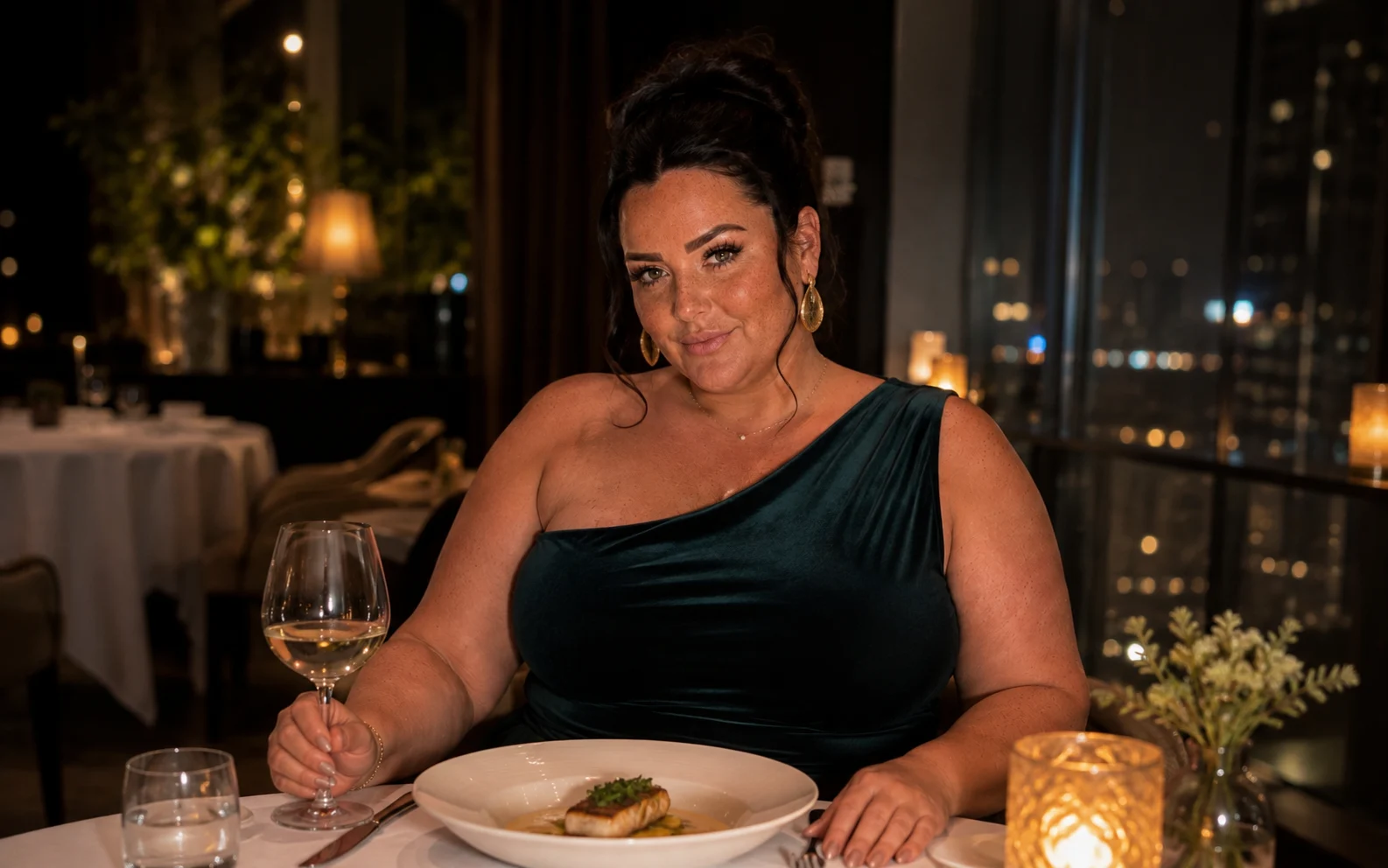
A larger woman eating in public gets looked at. Sometimes it is imagined and sometimes it very much is not, and there is no useful way to tell in the moment.
What I have arrived at is not confidence exactly. It is closer to a decision: I am going to eat the meal I came here for, and if someone is running a private commentary about it, that is an activity they have chosen to spend their evening on, and it is not one I am obliged to subsidise by ordering differently.
Some days that holds. Some days it does not. It holds more often than it used to.
What I will not do here
I am not going to give you a plan. No rules, no lists, no protocol. Not because I am being coy, but because I do not know anything about your body, your history, your relationship with food, or what would be helpful versus actively harmful for you.
If food is a difficult area — if there is a pattern that frightens you — that is worth taking to someone qualified. Not because you have failed at something, but because it is the kind of thing that gets easier with the right help and harder alone.
What I can offer is the smaller thing: drop the moral vocabulary and see what is left. In my experience, what is left is dinner.