What to say when someone comments on your daughter’s weight
A grandparent, a friend, a stranger in a shop. Calm replies for when someone comments on your daughter’s weight, and what to tell her afterwards.
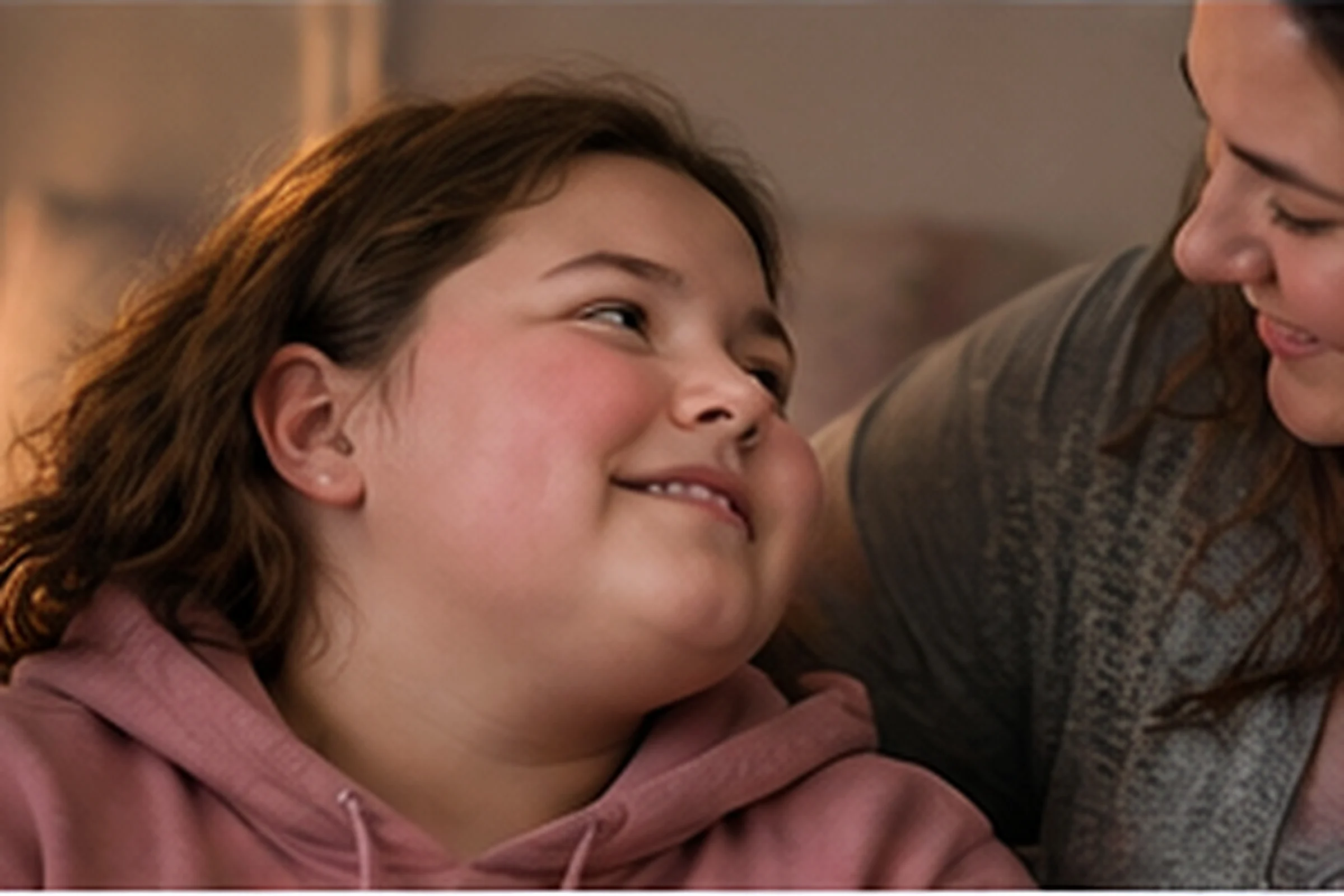
It happens at the worst possible moment, which is to say in public, with her standing right there. A grandmother at the door: Someone’s been enjoying her dinners! A friend’s approving glance: Hasn’t she slimmed down? A woman in a shop, a cousin at a party, a coach at the side of the pitch. And your daughter, who is eight or eleven or fourteen, looking at the floor and waiting to see what you will do.
What you do next matters more than what they said. So it is worth deciding in advance.
Answer in front of her
The instinct is often to smooth it over and deal with it later, privately, adult to adult. Do that as well. But say something in the moment, because she is listening to you far more closely than to them. If the comment goes unanswered, she learns that remarks about her body are an ordinary part of family life and that the adults who love her agree with them. If you answer — briefly, calmly, without a scene — she learns that her body is not public property and that you are on her side.
You do not need a speech. You need one sentence you have already practised.
Lines for the moment
- To a relative: “We don’t comment on bodies in our family.” Then change the subject: “Tell her about your trip.”
- To a “compliment” about weight loss: “She’s having a brilliant term, actually — she’s just finished a big science project.” Redirect to something about her that has nothing to do with her size. Praise for shrinking is still a comment on her body, and it teaches the same lesson in a nicer voice.
- To a friend: “We try not to talk about weight around the girls.” Friends usually take the hint, and many will be quietly relieved to have the permission.
- To a stranger: “That isn’t something we discuss.” Then walk away. You owe a stranger no further conversation.
- If it keeps happening: “Please don’t talk about her body. I’ve asked before.” Said evenly, in front of her. The repetition is the point.
Notice what these lines don’t do. They don’t argue about whether she is big or small, or reassure anyone that she is “perfectly healthy”. The moment you start defending her size, you have accepted that her size was up for discussion. Defend her, not her measurements.
The conversation afterwards, adult to adult
Later, when she isn’t there, have the fuller version with the person who said it — particularly if it is family, and particularly if it is likely to happen again. Most people who comment on a child’s weight believe they are helping, and a calm explanation lands better than an accusation.
The explanation is not a matter of opinion. In guidance for parents of teenagers, the American Academy of Pediatrics advises avoiding “weight talk” — comments about a child’s weight or your own — and never teasing about weight, because both are linked to disordered eating. Researchers who studied these conversations directly found that when parents talked to teenagers about weight, the teenagers were more likely to diet, use unhealthy weight-control methods and binge eat; when the conversations were about eating well, without mentioning size, those risks were lower.
So you might say: “I know you care about her, and I’m grateful for that. But comments about her weight make things worse, not better, so we’ve decided nobody talks about it — including us. If you’re ever worried about her health, talk to me, not to her.”
And if they say, as some will, that they are only concerned about her health: “Her doctor keeps an eye on her growth. That’s where that conversation belongs.”
Why the comments often arrive around puberty
Many of these remarks come at exactly the age when a girl’s body is supposed to be changing fastest. As girls grow, gaining weight is normal and expected. According to the American Academy of Pediatrics, a girl at the 50th percentile gains about four times as much weight between the ages of 10 and 14 as she does between 16 and 20, and rising oestrogen means her body fat increases and settles on her hips and breasts. What a relative sees as “filling out” is very often simply growing up.
Children are still growing, which is why doctors don’t judge their weight by eye. They plot it on growth charts and use BMI percentiles specific to a child’s age and sex, comparing her with other girls of the same age. A grandmother’s glance is not a growth chart. If you do have a question about your daughter’s health, take it to her doctor, and ask to have the first part of that conversation without her in the room.
What to say to her
Afterwards, on the way home or at bedtime, check in without making it a production. Something like: “I didn’t like what Granny said about your body. Nobody gets to comment on it, and I’ll always say so. How did it feel?”
Then listen. She may shrug it off, or she may tell you it has happened before and she never mentioned it. Try not to pile criticism onto the person who said it; she probably loves them, and you want her to feel protected, not caught between you.
Over time, what protects her most is what she hears at home when nobody is commenting on anything. No remarks about her food. No remarks about other people’s size, including the ones you make about your own, which she is taking in whether or not you think she is listening. Research on mothers and daughters suggests girls absorb their mothers’ criticisms of their own bodies. Family is often the first place a girl learns to dislike her body, and the moral language we use about food does a great deal of that teaching.
She will hear things about her body for the rest of her life. You cannot stop all of them. But you can make sure that the first voice she learns to trust on the subject — yours — was the one that said it was hers.
Sources
- Golden NH, Schneider M, Wood C, et al. Preventing Obesity and Eating Disorders in Adolescents. Pediatrics, 2016.
- Berge JM, MacLehose R, Loth KA, et al. Parent conversations about healthful eating and weight: associations with adolescent disordered eating behaviors. JAMA Pediatrics, 2013.
- American Academy of Pediatrics, HealthyChildren.org. Physical Development in Girls: What to Expect During Puberty.
- Centers for Disease Control and Prevention. Child and Teen BMI Categories.
- Handford CM, Rapee RM, Fardouly J. The influence of maternal modeling on body image concerns and eating disturbances in preadolescent girls. Behaviour Research and Therapy, 2018.