I built a home that does not ask me to shrink
Most rooms are designed with an assumed body in mind, and it is not mine. On chairs, doorways, mirrors, and making a space that does not require constant negotiation.
You learn a lot about a room by watching who has to adjust in it.
Narrow gaps between furniture that some people walk through and others turn sideways for. Chairs with arms set at a width that was decided by someone, once, with an assumed body in mind. Booths bolted to the floor. A gap between a table and a banquette that determines whether the evening is comfortable.
None of it is hostile. It is just designed for a default, and if you are not the default you spend a low-level amount of every day negotiating with the furniture.
The house was doing it too
What took me longer to notice was that I had reproduced all of this in my own home, where I had complete control and nobody to answer to.
The dining chairs had arms and were slightly too narrow. The armchair I sat in every evening was not comfortable and never had been. There was a mirror in a hallway hung at a height and angle that produced an unflattering view of everyone who passed it, which I had walked past several times a day for years without once considering that I could simply move it.
I had furnished a house for a body I did not have, and then lived in it, and treated the resulting daily friction as a fact about me rather than a fact about the furniture.
I had complete authority over one building in the world and had still made myself a guest in it.
What I changed
Chairs without arms, or with arms set generously. This was the single biggest change and it cost less than I expected, and I now sit down in my own home without a half-second calculation I had not known I was making.
Fewer, larger pieces. Crowding a room with small furniture creates a lot of gaps that have to be negotiated. Fewer things, better placed, and suddenly you can cross a room without thinking about it.
Wider routes. I measured the gaps between things. Once you have measured them you cannot unsee the ones that are grudging.
The mirror, moved. Full length, flat against a wall, in decent light, at a height that shows the whole person. It is remarkable how much of what I had assumed was my reflection was actually the installation.
The things nobody measures
Once I started measuring, I could not stop, and a few of the findings were genuinely absurd.
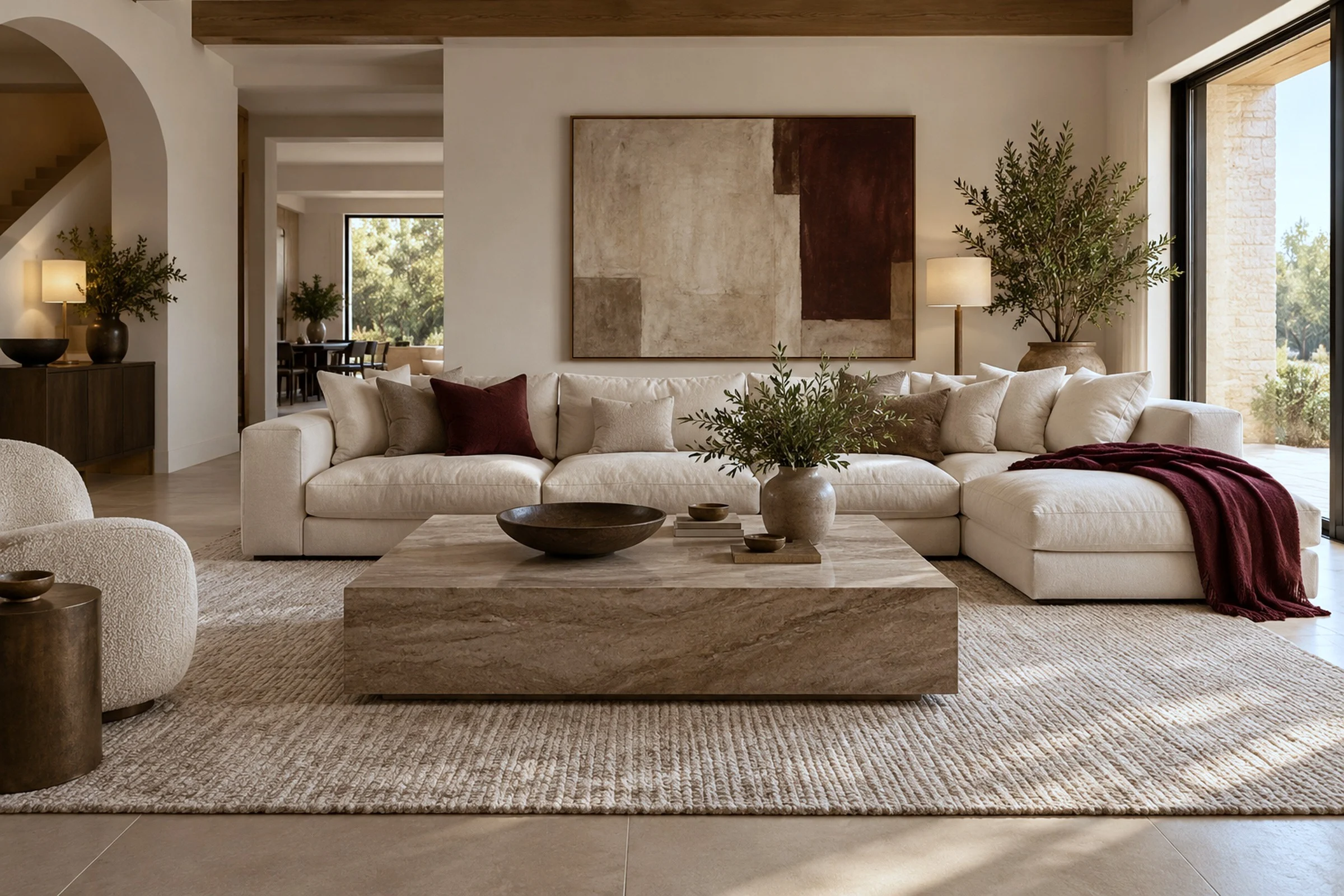
The gap between my sofa and the coffee table was fifty-one centimetres. I had been turning sideways to cross my own living room, several times an evening, for years, and had never once registered it as a solvable fact rather than a feature of the room.
The bathroom door opened inwards into a space that made it awkward to close behind me. A cupboard needed the door fully open, which meant standing in the doorway, which meant the doorway could not be used.
None of these were dramatic. Each was a small daily indignity that I had absorbed as information about my size rather than information about a floor plan. Moving the coffee table thirty centimetres took ninety seconds and removed something I had been quietly experiencing every day since I moved in.
What a room says
There is a phrase I keep coming back to: furniture is an argument about who a space is for.
A narrow chair with fixed arms is an argument. A booth bolted to the floor is an argument. Neither was written with hostility — someone was optimising covers per square metre — but the argument is made regardless, and it is made to the person who cannot sit down.
Which is why the home version mattered so much once I saw it. Everywhere else, I am subject to other people’s arguments about who the space is for. Here I make the argument. It seemed a waste to spend that authority reproducing everyone else’s conclusion.
Storage, honestly
A smaller point that mattered more than it should. I stopped keeping clothes that do not fit.
Not as a purge, and not with any ceremony. It is simply that a wardrobe half-filled with garments you cannot wear is a piece of furniture that tells you something every morning, and what it tells you is that the current situation is temporary and slightly regrettable.
Now everything in there fits. Getting dressed became a much quieter activity.
Comfort is not the opposite of beautiful
I resisted some of this because I had absorbed the idea that comfortable furniture is inherently ugly. That the choice is between a beautiful room and a usable one.
That is a false choice and I think it comes from a particular kind of interiors photography, in which rooms are styled for the camera rather than for occupancy. Those rooms are frequently unusable — that is not a compromise they made, it is the brief.
A generous, well-made chair in a good fabric is not a concession. It is just a good chair.
The test
The question I now ask about any room is straightforward: can I move through this without adjusting?
Not “does it look right.” Can I sit, stand, cross, reach and rest without a single small negotiation. If the answer is no, something in the room is wrong, and it is much easier to move a chair than to keep apologising to it.
Your home is the one place that does not get to have an opinion about your size. It is worth insisting on that, and it is mostly a matter of furniture.