On buying the chair I could not justify
I walked past it four times before I bought it. On taste, money, the ridiculous sums we do to make wanting things respectable, and what happens when you live with one.
I walked past it four times. Four separate occasions, over about six weeks, each time doing the same performance: pause, look, make a small amused face at myself, walk on. As though the walking on were evidence of good character.
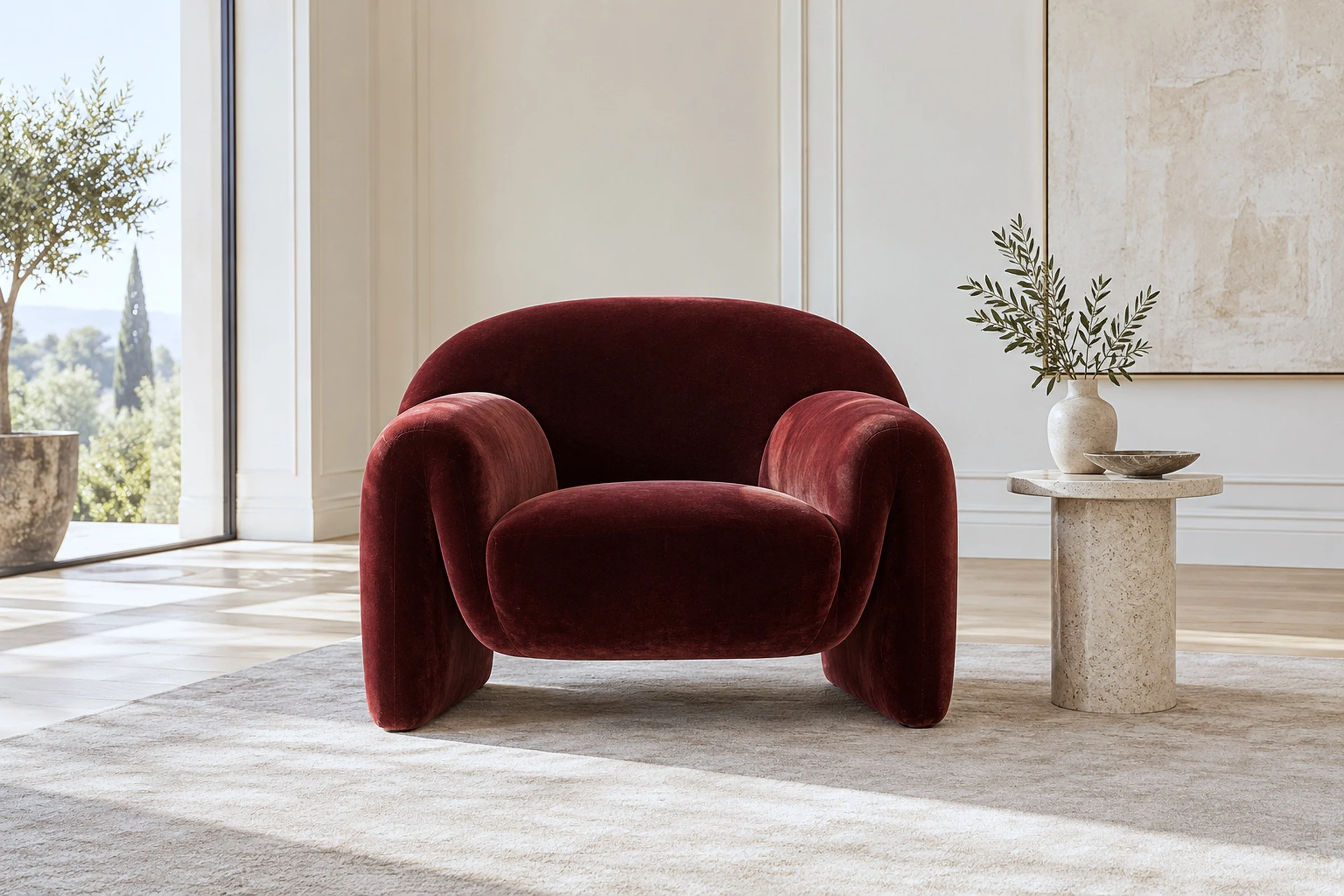
It’s a chair. Cream bouclé, heavy, sculptural in a way that makes people either love it immediately or ask whether it’s meant to look like that. It cost more than any single piece of furniture I had ever bought, by a margin I found genuinely uncomfortable.
I bought it on the fifth visit and I have not had one moment of regret, which is not the ending I expected and not, I suspect, the ending I’d have predicted for anyone else.
The arithmetic we invent
What fascinates me, looking back, is the sheer volume of mathematics I performed in those six weeks. None of it was real mathematics. All of it was theatre.
I calculated cost-per-year, which is the classic move. If it lasts fifteen years, it’s only this much per week, and put like that it’s practically thrifty. I compared it against things I’d spent similar amounts on without agonising at all, and noted with some irritation that a holiday which lasted nine days had prompted no soul-searching whatsoever.
I considered whether it was an investment. It isn’t. Almost no furniture is. That’s a story we tell to make desire respectable by disguising it as strategy.
And then I did the one I’m least proud of, which is that I looked for a cheaper version. There’s always a cheaper version. I found several. And I stood there knowing perfectly well that I’d buy it, be pleased for a fortnight, and then spend two years looking at it and seeing the thing it wasn’t.
That’s the false economy nobody accounts for. The cheaper thing you don’t quite want is not cheaper. You pay for it twice, once in money and once in the low-level dissatisfaction of living beside a compromise.
What I actually needed to admit
The justification I was hunting for didn’t exist, because the chair wasn’t solving a problem. I had somewhere to sit. I had, if anything, a surplus of places to sit.
What I couldn’t say out loud, for weeks, was the only true sentence in the whole business: I want it because it’s beautiful and I want to look at it every day.
That sentence felt indulgent. Frivolous, even. Which is interesting, because I’d have accepted it instantly from anyone else. If a friend told me she’d bought something gorgeous purely because it made her happy, I’d have been delighted for her. Applied to myself it became evidence of poor character.
There’s a specific hesitation that arrives when a fat woman spends money on herself, and I want to be careful here, because I don’t want to make a chair carry more than it can hold. But it’s real. Somewhere in the culture there’s a persistent notion that a larger woman should be modest in her wants — that visible pleasure, visible spending, visible enjoyment of her own life is a bit much on top of everything else. Small and grateful is the assigned position.
I’ve never been small or especially grateful, so it was always going to be an awkward fit.
What the six weeks were actually doing
I’ve since decided the delay was the most sensible part of the whole business, though not for the reason I thought at the time.
I assumed I was being responsible. Deliberating. Weighing it up like a serious person. In fact I was doing something much simpler and much more useful: I was finding out whether the wanting would survive contact with ordinary life.
Most wanting doesn’t. I’ve had strong, urgent, entirely convincing desires for objects that evaporated within four days of my not buying them. A coat I was certain about in October and could not identify by November. A set of glassware I thought about for a fortnight and then never again.
The chair kept turning up. Not as a nagging thought — I wasn’t tormented — but it stayed present in a low, steady way that the coat never managed. Six weeks in, it was still the thing I’d have chosen if someone had handed me the money.
I’ve made that my rule since, and it’s saved me a considerable amount of money by revealing how much of what I want is weather rather than climate. Wait a month. If it’s still there, it’s real. If you’ve forgotten about it, you’ve just been spared.
The unglamorous corollary is that this only works if you can afford it at the end of the month as well as at the beginning. A rule for delaying purchases is not a strategy for affording them.
Living with it
Here’s the thing I genuinely didn’t anticipate. I use it constantly.
I assumed it would be a display object — lovely, occasional, faintly ceremonial. Instead it’s become where I read, where I have coffee before anyone needs anything from me, where I sit when I want to think properly about something rather than think about it while doing four other tasks.
It’s also, and this matters more than I expected, a chair that fits me. Wide, deep, no arms clamping in from the sides. Anyone who has spent an evening perched in a chair that was clearly designed for a narrower body knows exactly what a difference that makes. It’s not a small thing to be able to sit down properly in your own home without adjusting yourself around the furniture.
So the object I couldn’t justify turned out to be one of the most-used things I own, and the useful lesson isn’t about spending. It’s that I was very bad at predicting my own behaviour. I assessed the chair as decoration because it was beautiful, as though beauty and function were opposed.
Buying fewer, better things is not automatically virtuous
I should be careful here, because there’s a whole genre of writing that takes an expensive purchase and launders it into a philosophy. Buy less, buy better. Quality over quantity. It sounds like restraint and it functions as permission.
Sometimes it’s true. A well-made thing genuinely does last, and there’s an old argument about boots — that the man who can afford good ones spends less over ten years than the man who keeps replacing cheap ones — which holds up for certain categories.
But it doesn’t hold up universally, and I notice it gets deployed most enthusiastically for things that are beautiful rather than things that are durable. Nobody makes the buy-better argument about a mattress with the same passion they bring to a coffee table.
The honest position is that I bought an expensive chair because I wanted an expensive chair. It happens to be extremely well made and I expect to have it for a very long time, and both of those are pleasing facts, but they were not the reason. They were the paperwork.
I’d rather admit that than pretend I was making a sober assessment of cost per annum. Desire is allowed to be desire. It doesn’t have to file a return.
What I’d say to someone standing in front of theirs
I’m not going to tell you to buy the expensive thing. That would be reckless, and I’ve no idea what’s in your account.
Debt for a chair is a genuinely bad idea. Six weeks of walking past it and it still being the first thing you think about on a Tuesday morning is different information entirely. The delay wasn’t indecision, as it turns out. It was a test I hadn’t realised I was running, and the chair passed it.
What I’d actually say is: stop looking for the argument that makes wanting it respectable. You’ll never find it, because it isn’t there. Beautiful things don’t come with justifications attached. Either you can afford it and it will genuinely please you for years, or you can’t, and that’s a real answer too, and not a moral one.
I’m in it now, as it happens. It’s got a slight mark on the left arm from something I’d rather not discuss.
Still the best money I’ve spent on my home.