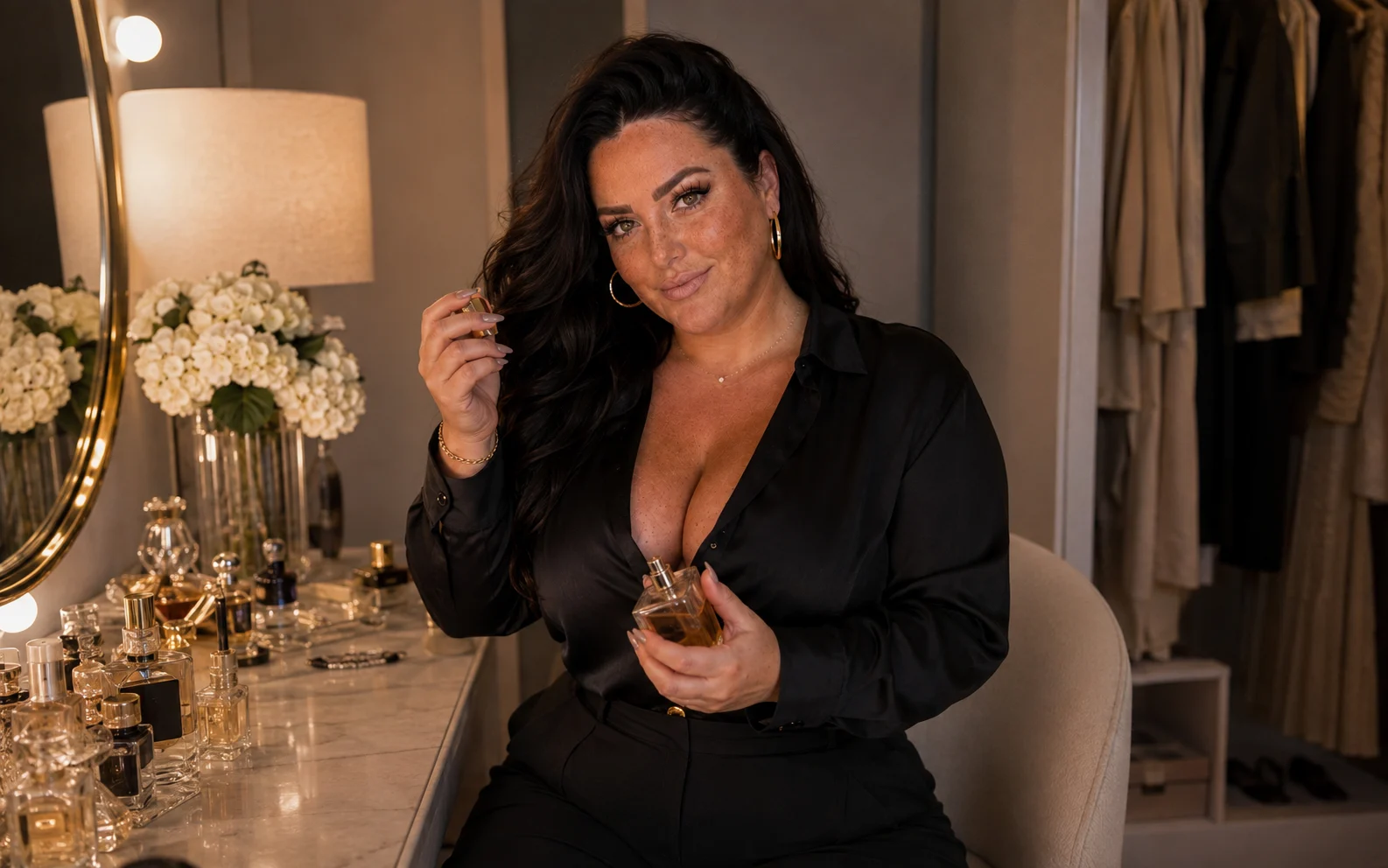
Makeup is not an apology
There is a difference between decorating something you like and correcting something you have been told is wrong. The products can be identical; the twenty minutes are not.
A woman I know does the most extraordinary eye makeup — precise, deliberate, entirely her own — and when someone compliments it she says “oh, I need it.” She does not need it. She is very good at it and she enjoys it, and she has been trained to present a pleasure as a repair.
I recognised it immediately, because I did the same thing for years.
Two identical routines
Two women can do the same twenty minutes with the same products and be doing completely different things.
One is decorating. The other is apologising in advance.
From outside you cannot tell. Same brushes, same result. The difference is entirely in what is assumed at the start — whether the face is the raw material or the problem.
The products are the same. The sentence underneath them is not.
How you can tell which one you are doing
A few questions I now ask myself, none of them profound:
How do I feel about being seen without it? Not “would I prefer to have it on” — would I cancel? Would I open the door?
Do I enjoy the doing, or only the finishing? Correction is something to get through. Decoration has a pleasant middle.
Do I ever do it when nobody will see me? That one is unusually diagnostic. If it only happens for an audience, it is doing a job, and it is worth knowing what the job is.
Where the apology gets installed
Almost every product I was sold in my twenties was described in terms of a problem. Correcting, concealing, minimising, perfecting, banishing, blurring, defying. Whole categories named after a fault.
You do not have to believe an advertisement to be shaped by it. Read enough of that language and you absorb the premise underneath it: that a face is a set of issues awaiting management.
What is odd is how rarely the same products get described the other way. The identical lipstick could be sold as a pleasure or as a repair, and it is almost always sold as a repair, because dissatisfaction converts better than delight.
I now notice the verbs. If everything in a description is a fix, I am being sold a diagnosis with a product attached, and I would rather just buy the lipstick.
The compliment problem
A smaller thing that took me a while: how badly I took compliments, and what that revealed.
Someone would say something kind and I would produce a deflection instantly — it is old, it is the light, I look terrible actually. Reflex, every time, before any thought was involved.
I used to think this was modesty. It is not. It is a correction issued to prevent someone from holding an inaccurate view, and it treats their kindness as an error to be fixed.
Saying “thank you” and stopping is unexpectedly difficult, and it does more than it should. The deflection is a small public act of disagreement with your own appearance, performed several times a week, and it lands on you as much as on anyone.
This is not an argument for wearing less
I want to be clear about that, because this genre usually ends up there — the tacit suggestion that the truly liberated woman has a bare face and a good moisturiser.
That is just a different standard with better PR. Choosing to wear nothing is a choice. Choosing a full face is also a choice. Neither is more enlightened, and I am deeply uninterested in the version of this conversation that ranks them.
I wear a lot of makeup. I like it. I like the smell of the products, the ritual of it, the fifteen minutes at a mirror with the radio on. That is not a compromise I have made with the patriarchy. It is a hobby I happen to wear on my face.
On the “you look tired” days
The question that clarified it for me was not about makeup at all. It was: what happens on the days I do not?
For years, what happened was that I stayed in. If the routine could not be performed, the day was reduced. That is when it had stopped being decoration and become a condition of appearing.
Now I go out with a bare face reasonably often. Not as a statement — I have simply stopped requiring the twenty minutes as an entry fee. Some days I want them and some days I do not, and both are available, which is the entire difference.
What I do differently now
Very little, technically. The routine is much the same. What changed is the order of operations in my head.
I decide what I want the face to look like before I start, rather than working out what needs fixing as I go. It sounds like a distinction without a difference and it is not — the first approach has a destination, the second has a list of faults, and you can feel which one you are doing about ninety seconds in.
I also stopped doing it in a hurry with bad light, which was making everything worse. Most of what I used to interpret as a bad face was, on inspection, a bathroom bulb.
And I keep things I like using rather than things that perform best. A lipstick I reach for because the case is pleasant is doing more for me than a superior formula I resent.
Ritual is worth defending
There is a tendency to treat beauty routines as frivolous, and I think that is wrong in a way that costs women something real.
A small daily ritual you perform for yourself, with your hands, that produces something you find pleasing — that is not vanity. That is one of the few reliably restorative things available on an ordinary Tuesday.
Keep the ritual. Lose the assumption that it is remedial. The products stay the same and the twenty minutes become yours.