What my grandmother’s kitchen taught me about taking my time
She cooked by looking, never by timing. What a kitchen teaches about attention, repetition and the things that flatly refuse to be hurried, including onions and possibly me.
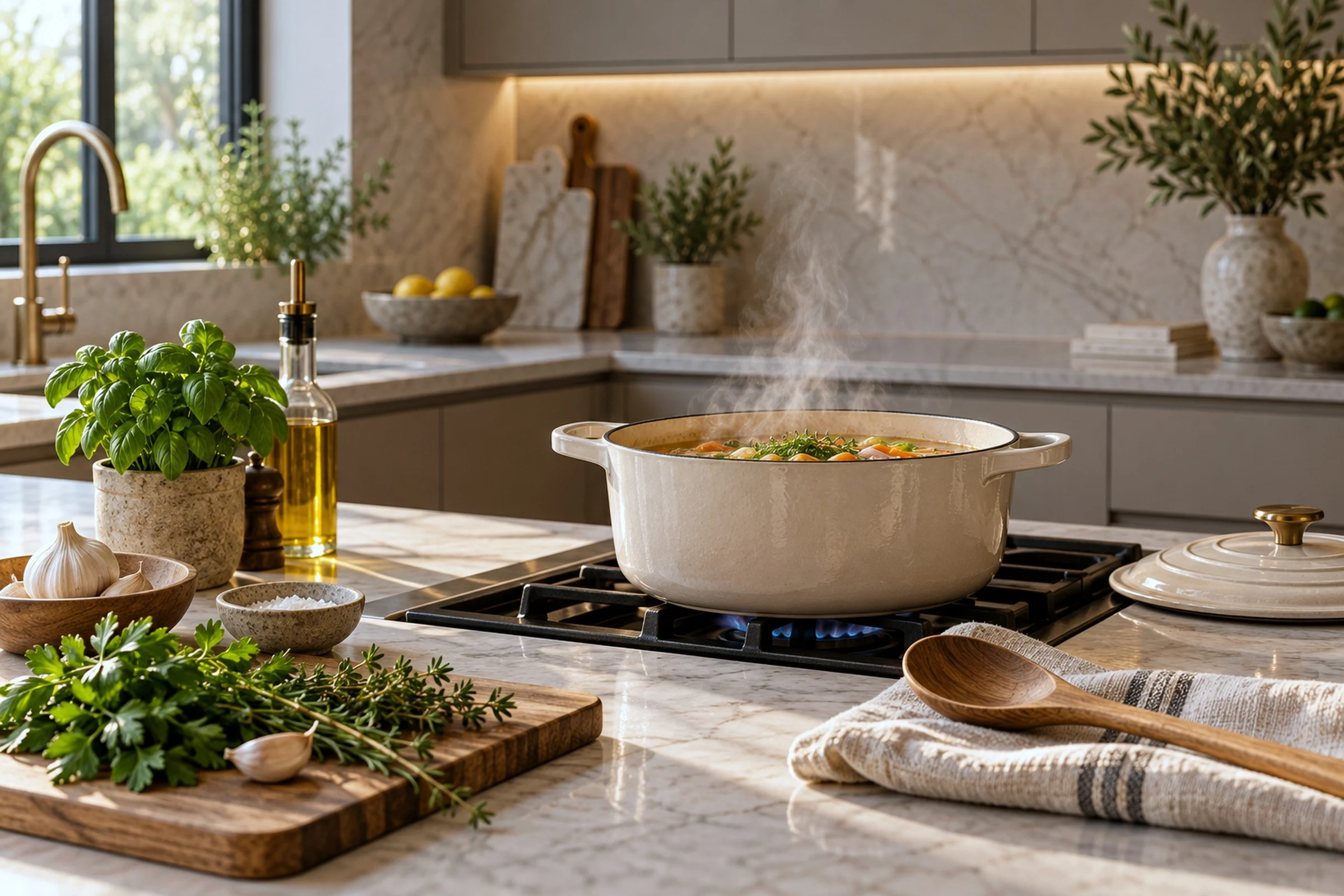
My grandmother’s kitchen had one good knife and no timer. I’ve been thinking about that a lot lately, mostly because my own kitchen has neither of those problems and I’m not sure it’s an improvement.
She cooked by looking. She’d lift a lid, consider, put it back. Come through, do something else, return. There was no anxiety in it. She wasn’t monitoring the food, she was living alongside it, and it got done because eventually it did.
I cook with my phone on the counter and a timer running and I check things constantly, as though a pan of onions might make a break for it.
Some things cannot be hurried
The thing about a kitchen is that it doesn’t negotiate. You can want the onions to caramelise in eight minutes as much as you like. They take the time they take, which is closer to forty, and every recipe writer who has claimed otherwise has done a small disservice to home cooks everywhere.
Bread rises at its own speed, adjusted by temperature, and no amount of checking accelerates it. Stock gets better the longer you leave it alone. Meat that’s been rushed is tough, and there’s no rescuing it afterwards. Rest a roast or don’t, but if you don’t, the juice ends up on the board instead of in the meat, and that’s just physics being unsentimental about your schedule.
I find this genuinely consoling. Almost nothing else in my working life has that quality. Everything else can be pushed, accelerated, delivered faster if I’m willing to sacrifice enough. A pot of beans cannot be persuaded.
What she was actually teaching
I don’t want to turn her into a symbol. She was a person, with moods, and there were days the kitchen was not a place of serene wisdom but a place where someone was irritated about a burnt bottom.
But she had a relationship with time that I’ve never managed to replicate, and I’ve come to think it wasn’t about patience at all. Patience implies waiting. Waiting implies you’d rather be somewhere further along.
She wasn’t waiting. She was just there, doing the next small thing.
The repetition was the point, I think. The same movements, in the same order, in the same space, thousands of times. Wipe the surface. Fill the kettle. Turn the heat down. It looked like drudgery to me when I was younger and it looks like something closer to competence now. She wasn’t performing efficiency. She had simply done it enough that her hands knew, and that freed up the rest of her.
We’ve lost some respect for that. The current culture around cooking is heavily invested in novelty — a new recipe every week, a new gadget, a new cuisine to master by Thursday. There’s very little glamour in making the same thing four hundred times until you can do it without thinking. And yet the people I know who cook best are all doing exactly that. They have eight dishes. They’re extraordinary at all eight.
The recipe is not the skill
I own an unreasonable number of cookbooks and I’ve come to think most of them are selling the wrong thing.
A recipe gives you a sequence. What it can’t give you is the judgement that sits underneath it — knowing that your pan is hotter than the writer’s pan, that your onions are larger, that the sauce wants another few minutes today for reasons to do with humidity and the particular tomatoes you bought. Recipes are written as though every kitchen were identical. None of them are.
The cooks I admire have all, at some point, stopped reading the instructions halfway through. Not out of arrogance. Because they’ve noticed something the page couldn’t have known.
That judgement is only available through repetition, and repetition requires you to accept a period of being mediocre at something. Which is where most of us fall down, myself very much included. I want to be good at things immediately. I’ve abandoned entire categories of cooking because the second attempt wasn’t better than the first, when the honest answer was that I needed a ninth attempt.
She’d made the same handful of things for decades. I used to find that limited. I now think it’s the closest thing to expertise I’ve ever watched at close range.
My kitchen is not her kitchen
I’m not going to romanticise this into a lesson about simpler times. Her kitchen was harder work than mine in ways that weren’t charming. Nobody’s grandmother was standing there thinking how wonderfully present she was being. She had things to do and fewer machines to do them with.
I like my dishwasher. I like being able to look up how long to steam something. I have no wish to return to any of it.
What I’ve taken isn’t the method. It’s the tempo.
These days I cook without anything playing. That was the change that surprised me most. For years I had a podcast on, or something streaming on a propped-up screen, on the theory that chopping is boring and boredom should be eliminated. Then one evening the wifi went down and I made dinner in silence and it was, unexpectedly, the best twenty minutes of the day.
Not because silence is virtuous. Because I could hear when the pan was ready. Because I noticed the smell change. Because my attention wasn’t split into three, and it turns out attention is quite pleasant when you give it all to one thing.
I do it most nights now. Sometimes it lasts ten minutes and then I put music on because I’ve had a horrible day and I want Fleetwood Mac. That’s allowed. It’s a preference, not a discipline.
I should say something else, because a kitchen is not a neutral room for a woman my size.
There’s a version of this essay where I leave that out, and it would be a slightly dishonest one.
Before that, though, the practical inheritance, because I don’t want to leave the impression that all she gave me was atmosphere.
She kept everything within reach. Salt by the hob, not in a cupboard. A bowl on the counter for scraps so she wasn’t crossing the room every thirty seconds. Knives sharp, which I resisted for years out of some vague nervousness and which turns out to be the single cheapest improvement available to a home cook. A blunt knife requires force, and force is what sends a blade skidding off an onion into your finger.
She cleaned as she went. Constantly. I found this baffling as a child, since the mess was going to be there at the end regardless, and I now understand it as the difference between cooking as pleasure and cooking as a task with a horrible tail on it. If the kitchen is tidy when you sit down, the meal ends when the meal ends.
And she tasted everything, at every stage, which sounds obvious and is the thing I see people skip most often. You cannot know what a dish needs by consulting a recipe. You know by putting a spoon in it.
Cooking well, eating well, taking obvious pleasure in food — those are read differently on me than on a smaller woman. A thin woman who loves butter is a delight. She’s relatable. A fat woman who loves butter is, in certain company, providing an explanation.
I’ve made my peace with that, mostly by declining to participate. But it’s why the kitchen matters to me more than it might otherwise. It’s the one place where my relationship with food is entirely between me and the food. Nobody’s face is doing anything. Nobody’s making a joke about the second helping. There’s just a pan, and a person who knows what she’s doing, and forty minutes that can’t be shortened.
She’d have found all of this quite overwrought, I suspect. She wasn’t given to reflection about the meaning of onions.
But she left me with the useful thing anyway, which is this: some jobs are not obstacles between you and your evening. They are the evening. Stand there. Turn it down. Come back in a bit.
It’ll be ready when it’s ready.