Why do we tidy up before the cleaner comes?
Plenty of people clean before the person they pay to clean arrives. It says a lot about who a home is performed for.
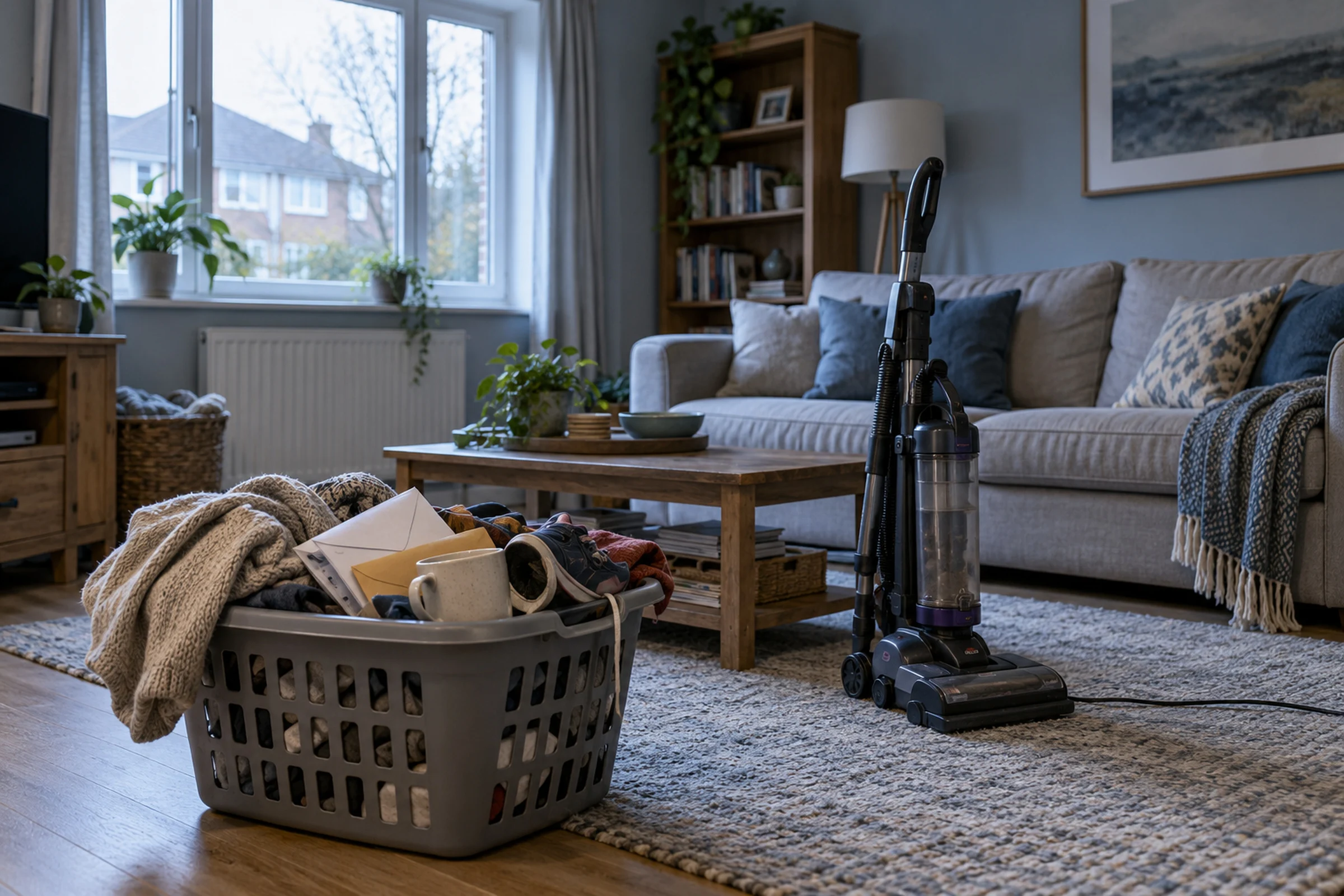
Plenty of people who pay someone to clean their home will admit to the same ritual. The night before, or in the half hour before the doorbell, they tidy. They clear the kitchen worktop, gather the clothes off the chair, put the post into a pile, wipe the obvious marks off the bathroom sink. Some go further and actually clean, before the person they are paying to clean arrives.
It is a joke people tell against themselves, usually with a laugh. I think it is worth taking seriously, because it says something about how much of home life is performed, and for whom.
The practical answer, and the other one
There is a sensible explanation, and it is partly true. A cleaner can clean surfaces far better when they are clear. Nobody wants to pay for an hour of someone moving piles of paper from one table to another. Tidying first is simply using the time well.
But the practical answer does not explain the wiping of the sink, or the anxiety about the state of the fridge, or the embarrassment people describe when someone arrives to find the washing-up from the night before. That is not efficiency. It is the feeling of being seen, and of wanting to be seen as a person who has things under control.
The home as a report card
For a lot of women especially, a home has long been treated as evidence. A clean, orderly house has been read as proof of a competent woman, and a messy one as a verdict on her, rather than on the number of hours in the day or the number of people who live there and do not tidy up after themselves. Plenty of us absorbed that before we could argue with it.
A cleaner is, awkwardly, the one person who is shown the evidence in full. They see the bathroom on a normal Thursday, the hair in the plughole, the pile of things that never quite got put away. It is intimate in a way we rarely acknowledge. So we tidy, the way we might tidy our faces before a photograph: not for the truth, but for the version of ourselves we would rather be judged by.
What strikes me is how little the other person usually cares. Someone who cleans homes for a living has seen far worse than your Thursday. The judgement we are guarding against is mostly our own, projected onto a stranger with a mop.
The same instinct, everywhere
The pre-clean is a small, funny version of something much larger. It is the same instinct that makes people apologise for the mess when a friend drops round, that stops them inviting anyone over until the spare room is sorted, that makes a home feel less like a place to live and more like a display that is never quite ready.
A home should be a place that does not ask you to shrink, or to perform. The moment you are tidying for the benefit of an imagined judge, the house has started working for them instead of for you.
What might help instead
I am not arguing that anyone should leave dirty plates stacked up for the cleaner out of principle. A quick clear of the surfaces is courteous and useful. But it might be worth noticing the difference between making the job possible and hiding the evidence of an ordinary life.
It is also worth noticing who does the pre-clean. In many households it is the same person who does most of the rest of the domestic thinking: who notices the soap is running out, who knows when the bins go out, who feels the state of the house as a reflection on her. If paying for help has not taken the mental weight off that person, the help is only doing half its job.
And if the reason you tidy before anyone comes round, cleaner or friend, is a low hum of shame about how you live, that is worth being gentle with. Rest and mess are not moral failures. Softness is not laziness, and a lived-in home is not a failed one.
The person with the mop is not grading you. Most of the time, nobody is. The home that needs tidying before it can be seen is still a home. It is just being lived in.