I stopped dressing to look smaller
Almost every styling rule I was given had the same hidden objective. Once I noticed it, most of my wardrobe stopped making sense — and getting dressed got considerably easier.
Here is a game. Take any piece of styling advice aimed at larger women and ask what it is actually optimising for.
Vertical stripes. A structured shoulder. Dark colours through the middle. A wrap dress, always a wrap dress. Something to “break up” the torso. A heel to “lengthen the line.” Avoid horizontal anything. Avoid volume. Avoid, above all, drawing attention.
Every single one has the same objective, and it is never stated: make the viewer perceive less of you. That is the whole brief. Decades of advice, a genuine industry, and underneath it one instruction repeated in different fonts.
The optical illusion problem
What struck me, once I saw it, is that none of this advice is about clothes. It is about optics. It treats getting dressed as a visual trick performed on other people, in which you are the material and the goal is to be less noticeable.
Which is a strange way to spend fifteen minutes every morning for thirty years.
I had been taught to dress as an apology with a hemline.
What I found when I stopped
I did an honest audit of my wardrobe with one question: why is this here?
A large amount of it was there for camouflage. Dark, shapeless, deliberately unmemorable. Not comfortable, not beautiful, not particularly practical — just quiet. Clothes chosen so that nobody would form an impression.
And a smaller pile of things I genuinely loved, most of which broke a rule. The red. The volume. The colour near my face. The thing with an actual pattern.
The loved pile got worn constantly. The camouflage pile got worn on the days I felt worst — which is to say, I had built a system that dressed me at my most invisible precisely when I already felt least substantial.
What replaced the rules
Not “wear whatever you want,” which is true but useless as guidance. Something more specific.
Does it fit? Not aspirationally — today, on this body, without adjustment.
Can I move? Sit, reach, climb stairs, eat a full meal, get through an evening without a single covert adjustment in a mirror.
Do I like the fabric against me? This one turned out to matter far more than I expected. A significant amount of what I thought was insecurity was, on inspection, a waistband.
Do I want to be seen in it? Not will this pass — do I actively want it.
The dress that broke the rule
There was a red dress. Short sleeves, a defined waist, a full skirt — a garment that violated essentially every instruction I had ever been given about what I should wear.
I bought it in a slightly defiant mood and then did not wear it for four months. It hung there as an intention.
When I finally wore it, two things happened, and neither was what I had braced for. The first is that I got more compliments in one evening than in the previous year of careful neutral dressing. The second, and more important, is that I forgot about my clothes for several hours — which had not happened in a very long time, and which I had not realised was available.
The camouflage wardrobe had never made me less self-conscious. It had made me self-conscious in a quieter register, all the time, forever. A garment I actively liked simply removed the subject from my attention for an evening.
What the rules are actually protecting
Once you notice that every rule optimises for taking up less visual room, a further question follows: whose comfort is that for?
Not mine. The rules made getting dressed harder, longer and less enjoyable, and produced clothes I did not like. They were not serving my comfort in any sense I can identify.
They serve the viewer. Specifically, a hypothetical viewer who would prefer not to be confronted with a larger woman who has not made an effort to appear otherwise. The whole framework is an etiquette — a set of manners for having a body, in which the polite thing to do is to minimise the imposition.
I am not willing to be polite about my own dimensions any more. Not out of defiance, particularly. It is just an enormous amount of work in service of someone else’s ease.
Fit is the whole thing
The most useful discovery was dull: most of what reads as an unflattering garment is a badly fitting garment, and most of what reads as a flattering garment is one that fits.
Shoulders in the right place. A hem that finishes where you meant it to. A waist that sits where your waist is rather than where the pattern-cutter assumed. Sleeves the correct length. That is most of it. It is not a silhouette secret, it is tailoring, and it is astonishing how much better even inexpensive clothes look once they actually fit.
A tailor is cheaper than a wardrobe of things you never wear.
What I wear now
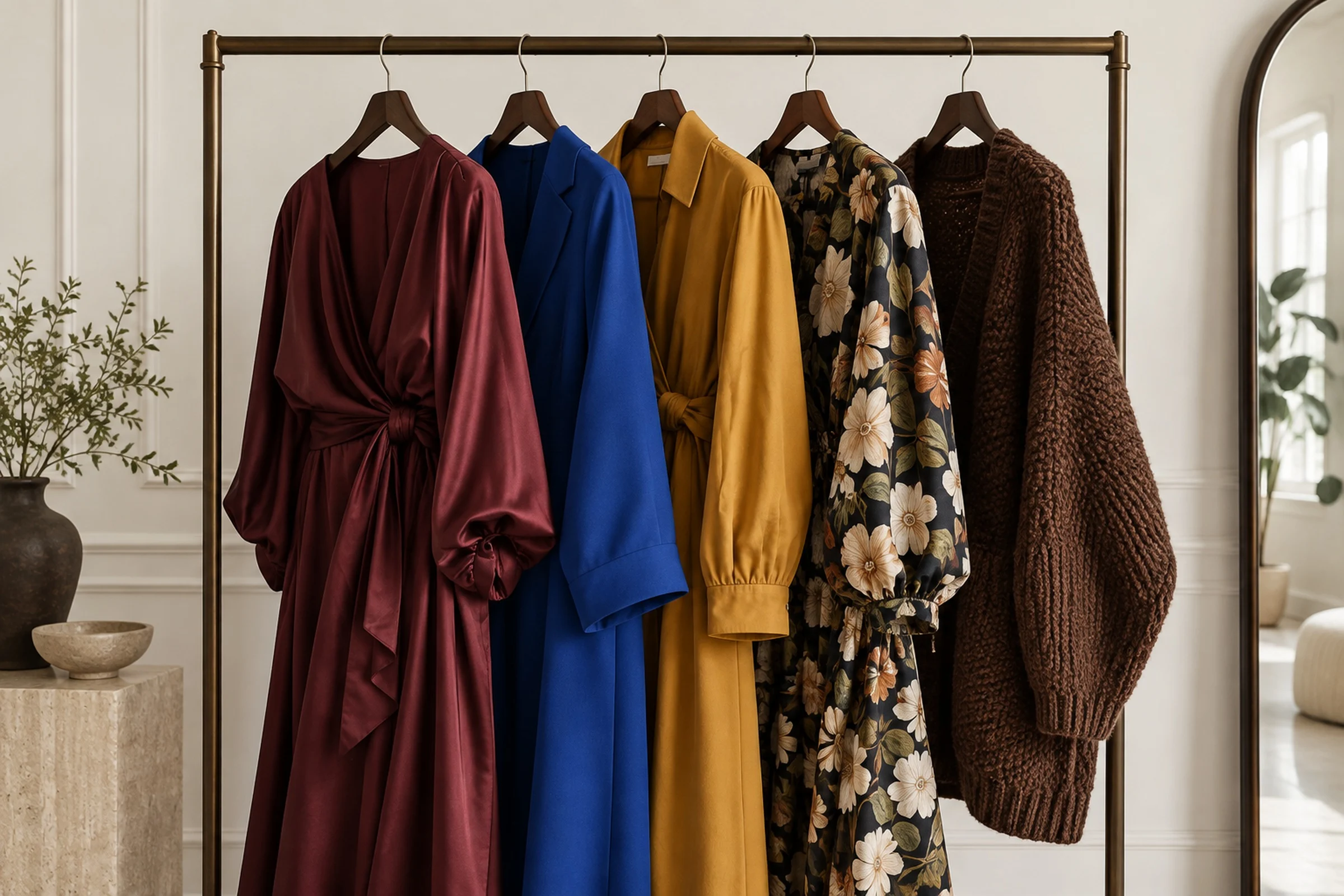
More colour, because I like colour and had been avoiding it for reasons that turned out to be someone else’s. Clothes with a defined shape, not because a shape is required but because I prefer the look. Good fabric, fewer items. Flat shoes far more often than the advice permits, since the advice was never interested in whether I could walk.
And black, still, frequently. Not as concealment. Because it is a beautiful colour and I look well in it, which is a completely different reason to arrive at the same garment.
The unexpected effect
Getting dressed takes less time now. That was not the goal, but it is the clearest measure that something changed.
When the question is does this make me appear smaller, there is no correct answer and the deliberation is endless. When the question is does this fit and do I like it, most mornings resolve in four minutes.
Clothes went back to being clothes. It took an unreasonable number of years and it was worth every one of them.