What I learned from wearing red before I felt ready
For fifteen years I owned nothing red and called it taste. On visibility, colour, and the myth that confidence must arrive before a woman is allowed to get dressed.
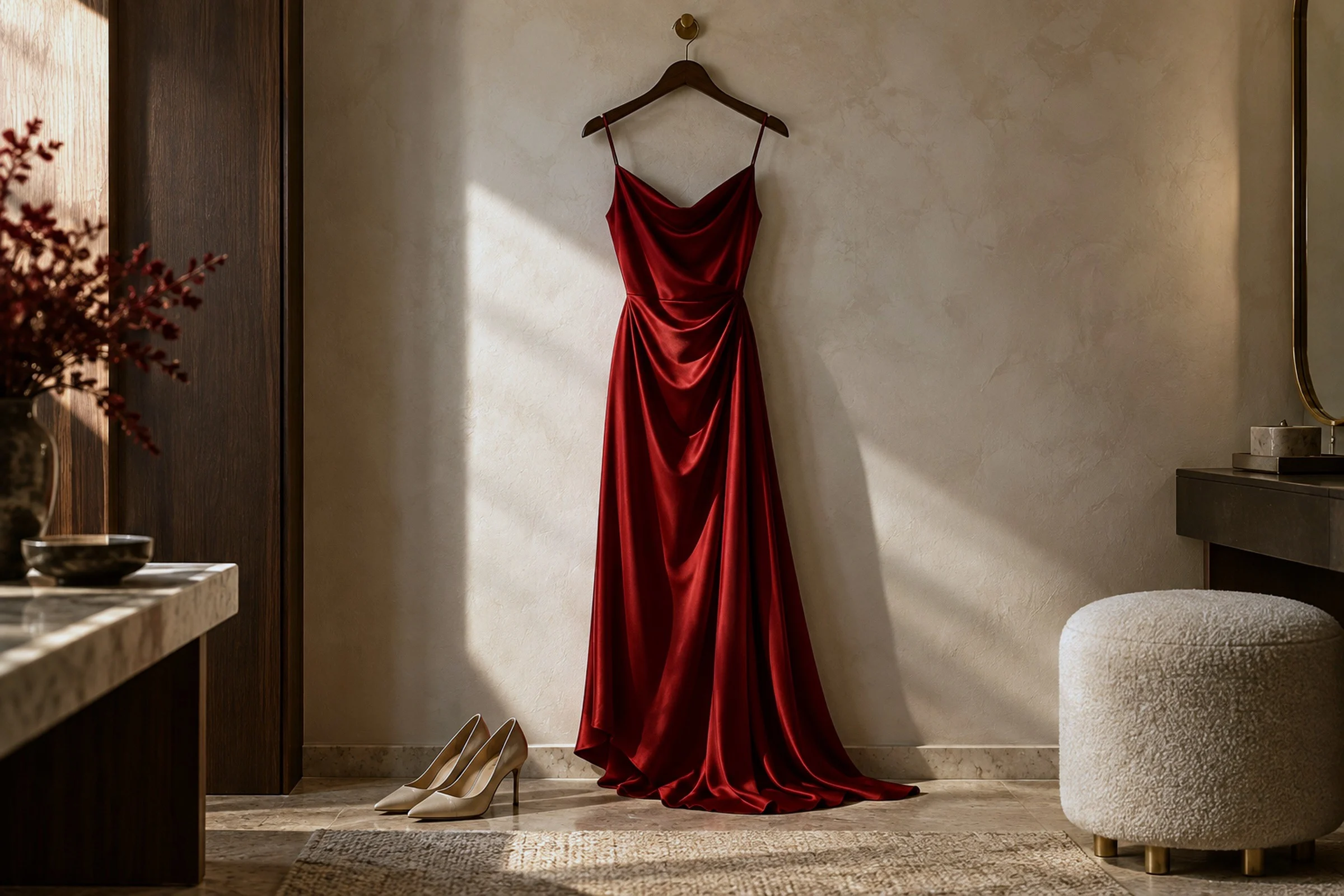
For about fifteen years I owned no red clothing at all. Not one item. I’d have told you, if you’d asked, that it wasn’t my colour.
That’s the phrase, isn’t it. Not my colour. Delivered with the confidence of a technical assessment, as though I’d had my complexion professionally analysed rather than absorbed, somewhere around nineteen, that red was for women who wanted to be looked at, and that wanting to be looked at was not available to me.
The rules nobody signed
Every fat woman receives the list. It’s never handed over formally. It assembles itself from magazine advice, well-meaning relatives, shop assistants and the general ambient noise of what’s considered appropriate.
Dark colours. Vertical lines. Nothing shiny. Nothing clinging. Nothing horizontal. Nothing that gathers at the waist unless it’s the right kind of gathering. Nothing sleeveless. Nothing white below the shoulder, which I think originates in some prewar notion about light colours advancing toward the viewer.
And above all, nothing that says look at me, because the underlying instruction beneath every single one of those rules is: reduce the amount of yourself that registers.
I followed it more or less completely through my twenties. I was very well dressed and almost entirely in navy, black, grey and an occasional daring olive. I thought I had refined taste. What I had was excellent camouflage and a genuine belief that it was a style choice.
What red actually is
Red is not subtle and has never pretended to be. It’s the colour with the longest wavelength the eye can register, it’s used for stop signs and warning lights for good practical reasons, and every culture that has had access to a decent red dye has made it mean something important.
For most of history it was also expensive. Proper colourfast red was difficult and costly to produce, which is why it turns up so persistently on people who were announcing status. That association hasn’t entirely gone away, even now that anyone can buy a red dress for very little.
So when you put on red, you’re not choosing a neutral. You’re choosing the visual equivalent of speaking up. Which is exactly why I avoided it, and exactly why I eventually wanted it.
Confidence does not arrive first
This is the belief I’d most like to take apart, because I held it for years and it cost me a great deal of enjoyment.
I thought there was an order of operations. First you become confident. Then, as a natural expression of that confidence, you wear the bold thing. The wearing is the outcome. The feeling is the prerequisite.
Under that model I was waiting for an internal event that was never scheduled. Some morning I’d wake up sufficiently self-assured, and then the red dress would be appropriate.
It doesn’t work that way and I don’t think it works that way for anybody. The feeling follows the behaviour far more often than it precedes it. You do the thing badly and self-consciously, and then slightly less so, and then one day you notice you did it without the internal negotiation.
I bought the first red thing while feeling entirely unready. That’s the honest sequence. I felt conspicuous and faintly ridiculous, like a woman in costume. I nearly changed twice before leaving.
The readiness came afterwards. Considerably afterwards, and in small instalments.
What I’d underestimated, though, is that people do look.
That part isn’t paranoia.
I’d spent so long theorising about visibility that I’d forgotten it has a physical component. Being noticed is a sensation, not just an idea, and the first few times it registered somewhere between my shoulder blades.
A large woman in a bright red dress attracts attention in a way a large woman in black does not. I’d spent years arranging my wardrobe around the avoidance of exactly this, so the first few outings involved a level of alertness I found genuinely tiring.
What I’d got wrong was the content of the looking. I had assumed it was hostile, because I’d spent my adolescence assuming all attention was. Overwhelmingly it isn’t. Most of it is neutral registering — the eye goes to red, that’s what red does, and then people carry on thinking about their own afternoon. A reasonable proportion is admiring. Women in particular will tell you, unprompted, in a lift.
A small amount is unpleasant. I won’t pretend it isn’t. There’s a species of man who finds a visibly confident fat woman personally provoking, and occasionally he says so. It happens less than the fear of it suggested, and it’s survivable, and I’ve found it easier to survive while dressed extremely well.
The dressing-for-your-shape industry
I want to say something slightly unfashionable about styling advice, because I don’t think it’s all nonsense and I dislike the pretence that it is.
Proportion is real. A garment cut a certain way genuinely does change how a body reads, and a person who understands line and balance can make you look extraordinary. That’s a craft, and I’ve benefited from it.
The problem is the objective. Nearly all of that expertise, when applied to a fat woman, gets pointed in one direction: minimise. Elongate. Streamline. Draw the eye away. The technical skill is real and it’s been conscripted into a single narrow project.
Imagine a stylist whose stated aim was to make you look as large and as magnificent as possible. It sounds absurd, doesn’t it. That reaction is the whole thing in miniature.
The body-shape frameworks — the fruit, the hourglasses, the whole apparatus — mostly function as a sorting system that tells women which parts of themselves are the problem to be managed. I used mine for years. I could have told you my assigned category and the corresponding list of forbidden necklines.
I’ve kept the technical bits and discarded the objective. I know what a strong shoulder does for me. I use it when I want the effect, not because I’m under instruction.
There’s a practical footnote to all this that I wish someone had told me earlier: red is not one colour. It’s dozens, and they behave completely differently.
A cool blue-red and a warm orange-red will do entirely different things next to the same skin, and most of the women I know who’ve decided red isn’t for them have actually met one unfortunate red once, in bad light, in a shop. That isn’t a verdict on the colour. It’s a verdict on that dress.
Fabric matters as much as shade. The same red in matte crepe and in satin are not remotely the same proposition — one absorbs light and one throws it back at the room. If you want the colour without the full announcement, matte is where to start. If you want the announcement, satin will do it for you.
And there’s a middle route that took me embarrassingly long to consider, which is that you can wear red somewhere other than a dress. A coat over black. Shoes. A bag. A mouth. I skipped straight from nothing to a full-length gown, which is very much my temperament but not the only available path.
What I wear now
Still a lot of black, as it happens. I wasn’t lying about liking it — I just hadn’t separated the liking from the hiding, and it took wearing red to work out which was which.
That’s the outcome I’d want to report, rather than a conversion story. I didn’t discover that my true self was flamboyant. I discovered that I’d never actually chosen, and that a preference you were never permitted to examine isn’t really a preference.
Now the black is a decision. So is the red, on the days I want it.
If you’ve got something hanging up that you’re saving until you feel like the sort of woman who could wear it: that day is not coming on its own. It arrives about four hours after you put the thing on and go out in it feeling like a fraud.
Wear it before you’re ready. Ready is downstream.