I no longer apologise for the way I take up a doorway
I used to turn sideways in doorways when nobody was coming. An inventory of the small ways women learn to shrink, and what it finally took to stand at full height.
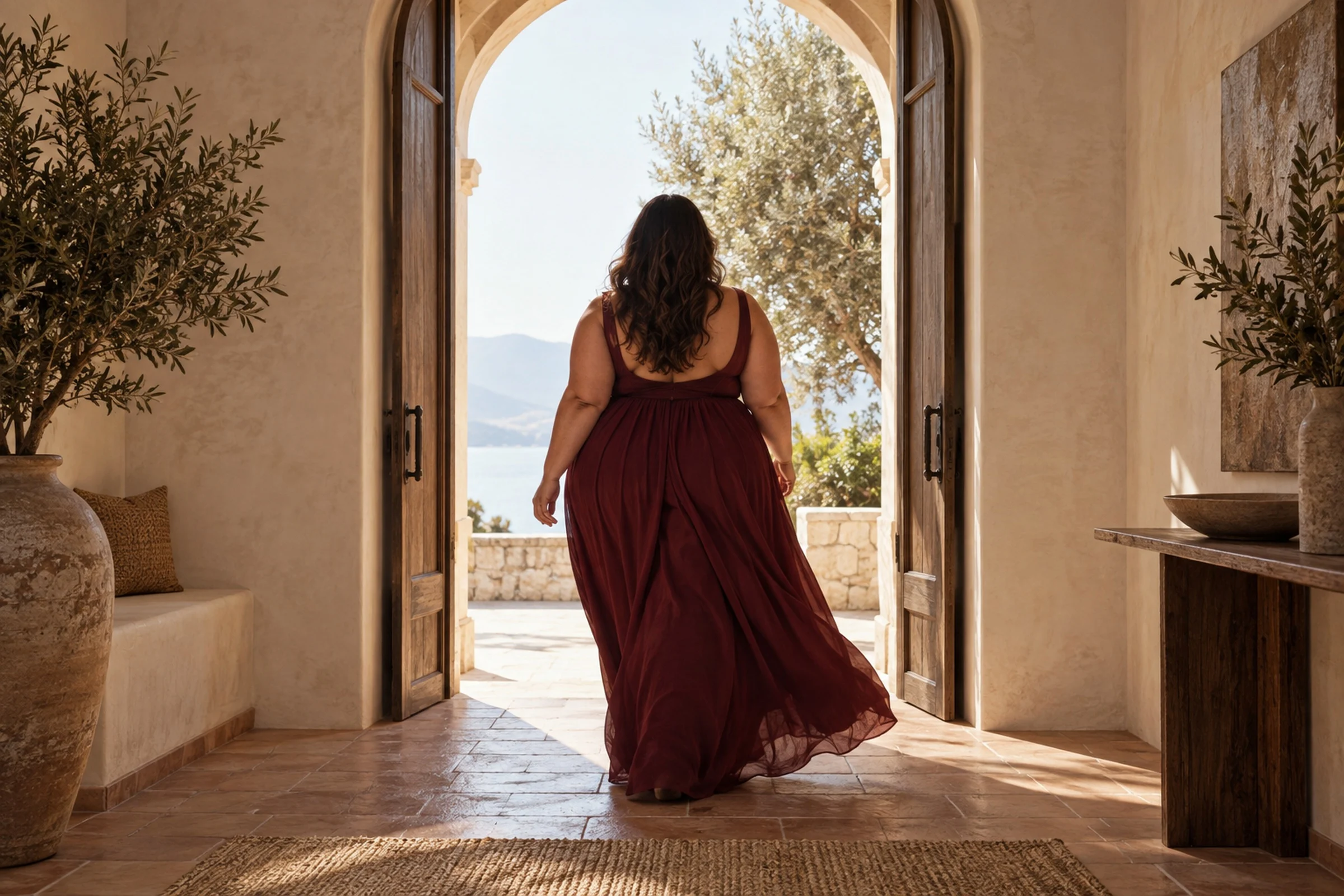
I used to turn sideways in doorways when there was nobody coming.
Not for anyone. Not to let a person past. Just a small automatic angling of the shoulders as I went through, a habit so worn-in that I’d been doing it for years before I noticed it, and then once I’d noticed it I couldn’t stop noticing it.
The doorway was wide enough. It was always wide enough. I was making myself narrow for an audience that did not exist.
An inventory of small disappearances
Once you start counting them, the list gets long and slightly humiliating.
Arms folded across the front, permanently, in any photograph and most conversations. Choosing the aisle seat not for the legroom but so that only one stranger has to sit beside me. Getting to a restaurant early to be settled before anyone watches me arrive. Standing at the back in group photos. Hovering near the edge of a room rather than crossing it. Apologising when someone else bumped into me.
Saying sorry, constantly, as a kind of ambient noise. Sorry for being here. Sorry for the space between us being the size it is.
None of it was conscious strategy. That’s what I want to be clear about. Nobody sat me down and taught me to shrink. It accumulated, the way a posture accumulates, out of a thousand tiny pieces of information about how a body like mine is received.
The photographs
I have almost no pictures of myself between about twenty-two and thirty.
Not because they weren’t taken. Because I deleted them, or asked for them to be deleted, or arranged to be behind someone in every group shot, or volunteered to be the one holding the camera. I was extremely helpful about photography for most of a decade, and it looked like generosity.
Whole years of my life with no visual record. Holidays I remember loving, evenings that were genuinely wonderful, and no evidence that I was there.
That’s the one that still catches me occasionally. The doorway thing is funny, in its way. The photographs aren’t. I removed myself from my own archive on the assumption that a future, better-looking version of me would be the one worth keeping, and she never showed up, and meanwhile the woman who was actually living that life went unrecorded.
I’m in everything now. Front row, arms unfolded. Some of them I don’t love. I keep them anyway.
Where it comes from
Some of it is straightforwardly practical, and I don’t want to be dishonest about that. Plane seats are narrow. Some restaurant booths are fixed. Certain chairs have arms that were designed by someone with a very particular customer in mind. There are real logistics involved in moving through a world built to a standard measurement, and pretending otherwise would be silly.
But most of the shrinking wasn’t logistics. It was pre-emptive.
I was trying to get ahead of the comment. If I made myself small enough, quiet enough, unobtrusive enough, then maybe the thing I was braced for wouldn’t come. The look. The remark disguised as concern. The particular flavour of laugh from a group of men on a street.
It doesn’t work, incidentally. That’s worth knowing. Twenty years of empirical research on my own behalf: making yourself smaller does not reduce the commentary. It just means you receive it in a diminished posture.
The thing that actually shifted it
I’d like to describe a moment of revelation. There wasn’t one. It was closer to attrition — a slow accumulation of being tired of it, which is a much less cinematic engine for change but a considerably more reliable one.
Part of it was simply getting older. Thirty-five has been good to me in ways I didn’t anticipate. There’s a recalibration that happens when you stop being quite so available to other people’s opinions, and mine arrived somewhere around thirty-two and has been gathering strength since.
Part of it was watching other women do it. Not fat women being defiant, particularly. Just women moving through rooms as though they were entitled to be in them. Taking the middle seat at the table. Speaking at ordinary volume. Not arranging their bodies for anyone’s convenience. I found it electrifying and then, gradually, imitable.
And part of it was physical, which surprised me most. I started standing properly. Shoulders down and back, weight even, chin level. Purely mechanical at first, the way you’d correct your posture at a desk.
It changed how I felt within about a fortnight. I’m wary of overclaiming here because the research on posture and mood is messier than the popular version suggests, and I’m not going to pretend standing up straight cured anything. But the ordinary version is true and doesn’t need a study: it’s very hard to feel apologetic while occupying your full height. The body was leading and the mind followed it, rather than the other way round.
The professional version
Work was where the shrinking cost me most, and where I noticed it last.
I had a habit of prefacing everything. This might be silly, but. I’m probably missing something here, but. Sorry, can I just ask. Every good idea I had went out wrapped in packaging designed to make it easier to dismiss, and then I’d be puzzled when it got dismissed.
I sat at the edges of meetings. Literally — I’d take the chair against the wall rather than one at the table, and tell myself it was because I preferred to observe. It was not because I preferred to observe.
There’s research suggesting larger people, women particularly, are read as less competent in professional settings before they’ve said anything, and I have no way of proving that happened to me specifically. What I can say is that I behaved as though it would, and that behaving as though it will is a remarkably efficient way of arranging for it to.
Dropping the prefaces was the single most useful change I’ve made to my working life. Not becoming aggressive. Just removing the apology and letting the sentence stand on its own. It felt appallingly rude for about a month, which tells you how much padding I’d been carrying.
Now I take a seat at the table. If the room is arranged so that there isn’t one for me, I ask for a chair, in front of everybody, and someone fetches it, and the meeting continues.
What it looks like now
I walk through doorways facing forward. That’s the small stupid one, and it’s the one that tells me most.
I sit down properly in chairs instead of perching. I put both arms on the table. I stand in the front row of photographs, which I resisted for years and now rather enjoy. I don’t fold my arms unless I’m cold.
I’ve mostly stopped saying sorry when I haven’t done anything. This one required active effort and I still catch myself. It’s astonishing how much of a woman’s vocabulary is padding.
And I wear things that are visible. White. Red. Cut close. Things that decline to blend into a wall. Not as a statement, though I appreciate that it reads as one. Genuinely just because I like them, and because the alternative was dressing to be less noticeable, and I’d been doing that since I was nineteen and had frankly run out of enthusiasm for it.
I want to be careful not to make this sound like triumph. I’m not walking around radiating serenity. Some days somebody says something on a train and it lands, and I’m quiet for the rest of the journey and cross about it that evening. That still happens. I’d be lying if I claimed otherwise, and the lie wouldn’t help anyone.
The difference is that it’s now an event rather than a condition. It happens to me. It isn’t the weather I live in.
I have a life I like enormously. Work that interests me, a home I’ve made carefully, people who are glad to see me, a great deal of ordinary pleasure. None of that was waiting on the other side of becoming smaller. It was available the whole time, and I spent years standing slightly to one side of it.
The doorway was always wide enough. I just had to stop turning.