The spa robe should fit you too
A spa day is sold as pure rest. For many women in bigger bodies it can feel like an exam. The questions worth asking before you book.
A spa day is sold as the purest kind of rest: warm water, soft light, nobody asking anything of you. For a lot of women in bigger bodies it can feel more like an exam. Will the robe close? Will the treatment bed hold me? Will I be the only one in the pool who looks like this? Will someone say something?
None of those questions is vain. They are practical, and most of them have simple answers that a spa can give you in advance. What makes them feel so heavy is that we are expected not to ask them, and to find out at the moment we are standing in a changing room in our underwear.
The robe is a small test
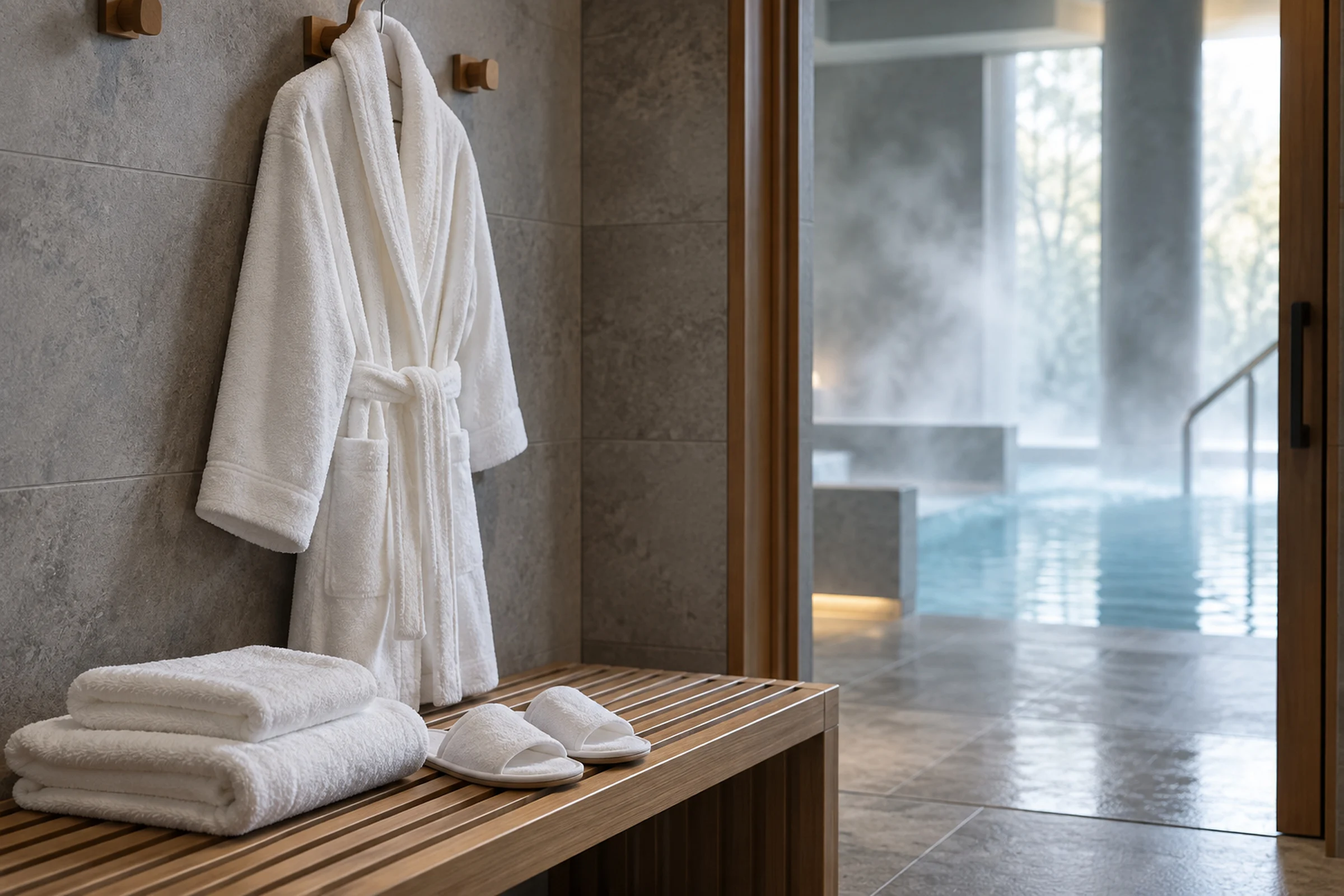
The robe is often the first thing handed to you, and it is where a lot of spa days start to go wrong. Many spas keep a “one size” robe that is really one size, and it does not close on many of the women who walk through the door. There is nothing quite like being given the uniform of relaxation and finding it does not fit.
It is not a small detail, because it tells you whether the place was imagined with you in it. And it is one of the easiest things to fix. Many spas already keep larger robes; they simply do not mention them. So ask, when you book: “Do you have robes in larger sizes? Could you put one aside for me?” If they do not, you can bring your own, or a long, loose cover-up, and nobody will think twice.
Ask the questions before you go
The single most useful thing you can do is ask your questions by phone or email when you book, not at the desk. It is easier to ask, easier to answer, and it gives you time to choose somewhere else if the answers are wrong.
- Robes and towels. Do they have larger robes, and can they keep one for you? Are the towels a decent size?
- Treatment beds. Massage and treatment tables are made with a stated weight capacity, which varies between tables. A good spa knows the figure for its own and will tell you without fuss. Some have wider or electrically adjustable beds, which are also easier to get on and off.
- Chairs and loungers. Are there armless chairs or sturdy loungers in the relaxation areas, not only narrow sculpted ones?
- Getting in and out of the pool. Are there steps with a handrail, or only a ladder?
- Changing. Are there private cubicles, not only an open changing room?
- Treatments. Can a massage be done side-lying, or seated, if lying face down is uncomfortable?
You do not need to explain why you are asking. “I’m a larger size and would like to check a few things before I book” is plenty. The way a spa answers tells you a lot. A warm, matter-of-fact reply is a good sign. Awkwardness or vagueness is useful information too.
At the treatment itself
You are allowed to direct a massage. You can ask for more or less pressure, for a towel to stay where it is, for a different position, or for a therapist to skip an area altogether. Therapists are used to this, and a good one would much rather know.
If anything is said about your body that you did not ask for, from a suggestion of a “slimming” wrap to a comment disguised as concern, you do not have to accept it. “I’m just here to relax, thanks” is a complete sentence.
Why it is worth it
It would be easy to read all this and decide a spa day is more trouble than it is worth. I think the opposite. Women in bigger bodies are often the ones who most need a day in which their body is cared for rather than assessed, and the ones who most often talk themselves out of it.
A spa, like an aeroplane seat, was usually designed around a narrow idea of a body. The answer is not to stay home. It is to ask the questions in advance, choose the places that answer them well, and walk in knowing you are expected. Taking up the space you take up is not an imposition on anyone.
The robe should fit you too. It is a small thing. That is exactly why it matters.