Seventeen inches: what actually happened to the aeroplane seat
Economy seats got wider, then narrower again. What that means for booking, which armrests lift, and why width matters more than legroom.
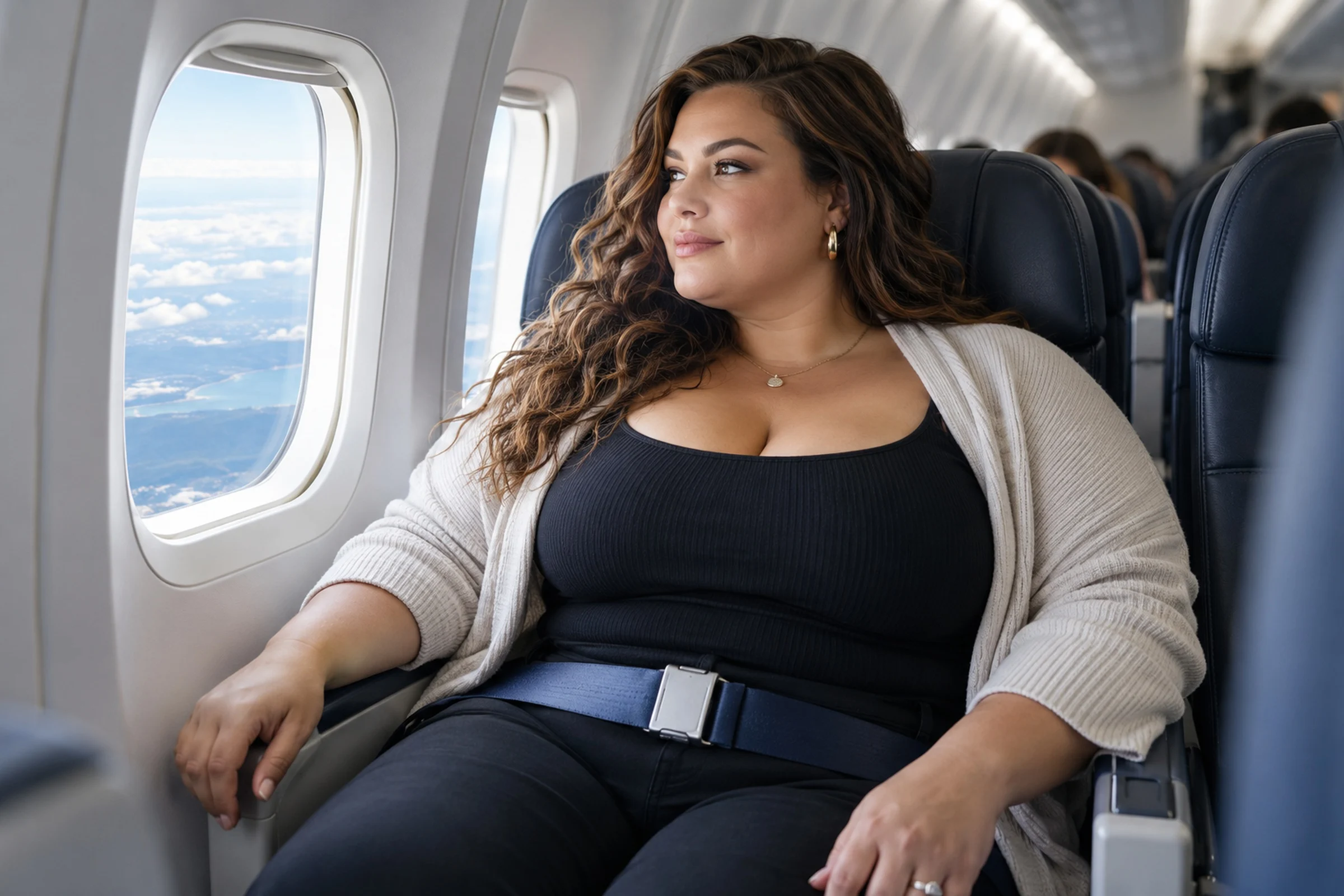
There is a widely repeated claim that aeroplane seats have been getting narrower for decades. It is not quite right, and the real history is more irritating than the myth.
Economy seat width sat around 17 inches in the 1960s. It then widened — to roughly 18.5 inches through the 1990s and 2000s, as wide-body aircraft like the 777 and A380 came into service. Over the past two decades it has been given back. Economy seats on current narrow-body workhorses such as the 737-800 are commonly quoted at somewhere between 16.3 and 17.8 inches depending on carrier and configuration.
So the seat is not a fixed inheritance from a smaller era. It is a commercial decision, revisited regularly, and currently going the wrong way.
Width is the number that matters, and nobody advertises it
Everyone compares legroom, because legroom is marketed. Seat pitch appears in fare comparisons and upgrade pitches. Width almost never does.
Yet width differs by an inch or more between aircraft types flying the same route for the same airline on the same day, and an inch is the entire difference between a tolerable flight and a braced one. A wide-body on a long-haul leg is frequently more comfortable across the shoulders than a narrow-body doing two hours, regardless of what the seat map suggests about legroom.
Independent seat-specification databases publish width by aircraft type and carrier. Check the aircraft, not just the fare — and check it again after booking, because equipment swaps are common and an airline is under no obligation to tell you the cabin changed.
The armrest is often the whole problem
Several things about cabin geometry are counterintuitive and rarely explained.
On many aircraft the aisle-side armrest lifts, which changes the usable width considerably. Some window seats have a fixed armrest because of structural housing at the fuselage. A middle seat between two raised armrests can therefore be more comfortable than a window seat with a fixed one — which is the opposite of what most people assume when choosing.
Bulkhead rows are not automatically better either. Where the tray table is stowed inside the armrest, that armrest is fixed and thicker, so the usable width is less than a standard row despite the extra legroom.
Extension belts are carried as standard equipment on commercial aircraft and cabin crew can provide one on request. Ask during boarding rather than during the safety demonstration; it is a quieter moment and the crew are not mid-procedure. Policies on bringing your own vary by airline and some prohibit it outright, so check rather than assume.
Policies: read them yourself, and screenshot them
Most carriers publish a passenger-of-size or customer-of-size policy. Very few surface it during booking, which is the only moment it would be useful.
Broadly they fall into three shapes. Some airlines ask that a second seat be purchased in advance and refund it afterwards under stated conditions. Some require the purchase without a refund. Some handle it at the airport, at the discretion of staff, by moving passengers into rows with space.
The differences are substantial and they change. Airlines revise these policies without announcement, and I am deliberately not reproducing individual carriers’ current terms here, because a policy quoted in an article is out of date the moment it is edited.
What holds regardless: find the policy on the airline’s own website before you book, read the refund conditions rather than the summary, and screenshot the page with the date visible. Gate staff and telephone agents frequently describe policies that differ from the published one, in both directions, and a screenshot settles it in about four seconds.
What to do before you get to the airport
Most of the difficulty is decided at booking, when it is still cheap to fix.
Book directly with the airline where you can. Third-party sites rarely pass through seat requests reliably, and a policy claim made to an agency is not a policy claim made to the carrier. If something needs arranging, you want one party responsible.
Choose the seat at booking, not at check-in. Paid seat selection is one of the few airline fees that reliably buys something specific for a larger passenger: a raised armrest, a row away from the galley queue, a companion beside you rather than a stranger.
Consider the routing, not only the destination. A single longer leg on a wide-body is frequently more comfortable than two short hops on narrow-bodies, even when the total time is worse. Two boardings is also two walks down the aisle.
Check whether the aircraft has been substituted in the days before departure. If it has, your seat may no longer be the seat you chose, and it is easier to move before the gate.
None of this is glamorous and all of it takes about fifteen minutes. It is the difference between a flight you plan and a flight that happens to you.
The part that is not logistics
Ask women what makes flying hard and the seat comes second.
What comes first is the walk down the aisle: a narrow corridor of seated people watching to see where you stop. Everyone who has done it recognises the specific arithmetic — reading faces, registering the relief as you pass, occasionally catching something less kind, and knowing that whoever you sit beside will have a reaction you will have to sit next to for four hours.
There is no technique that removes this. Women who describe it as having become manageable mostly describe the same two adjustments: boarding as early as the fare allows, so the walk happens to a half-empty cabin, and treating the whole thing as a transaction with an airline rather than a referendum held by strangers.
Going anyway
A striking number of women describe having quietly stopped travelling. Not by deciding to — by declining enough invitations that the question stopped being asked, and then noticing some years later that an entire category of their life had closed without anyone closing it.
The discomfort is real and worth planning around properly rather than enduring by default. Buy the second seat if it makes the difference and you can. Screenshot the policy. Choose the aircraft, not just the fare. Board early. Ask for the belt at a quiet moment.
It is four hours. What it buys is everywhere the aircraft goes.