“If you cared about yourself, you’d lose weight.” Let’s talk about that.
It sounds like concern. Look closely and the sentence makes three claims — about care, weight and shame — and the evidence supports none of them.
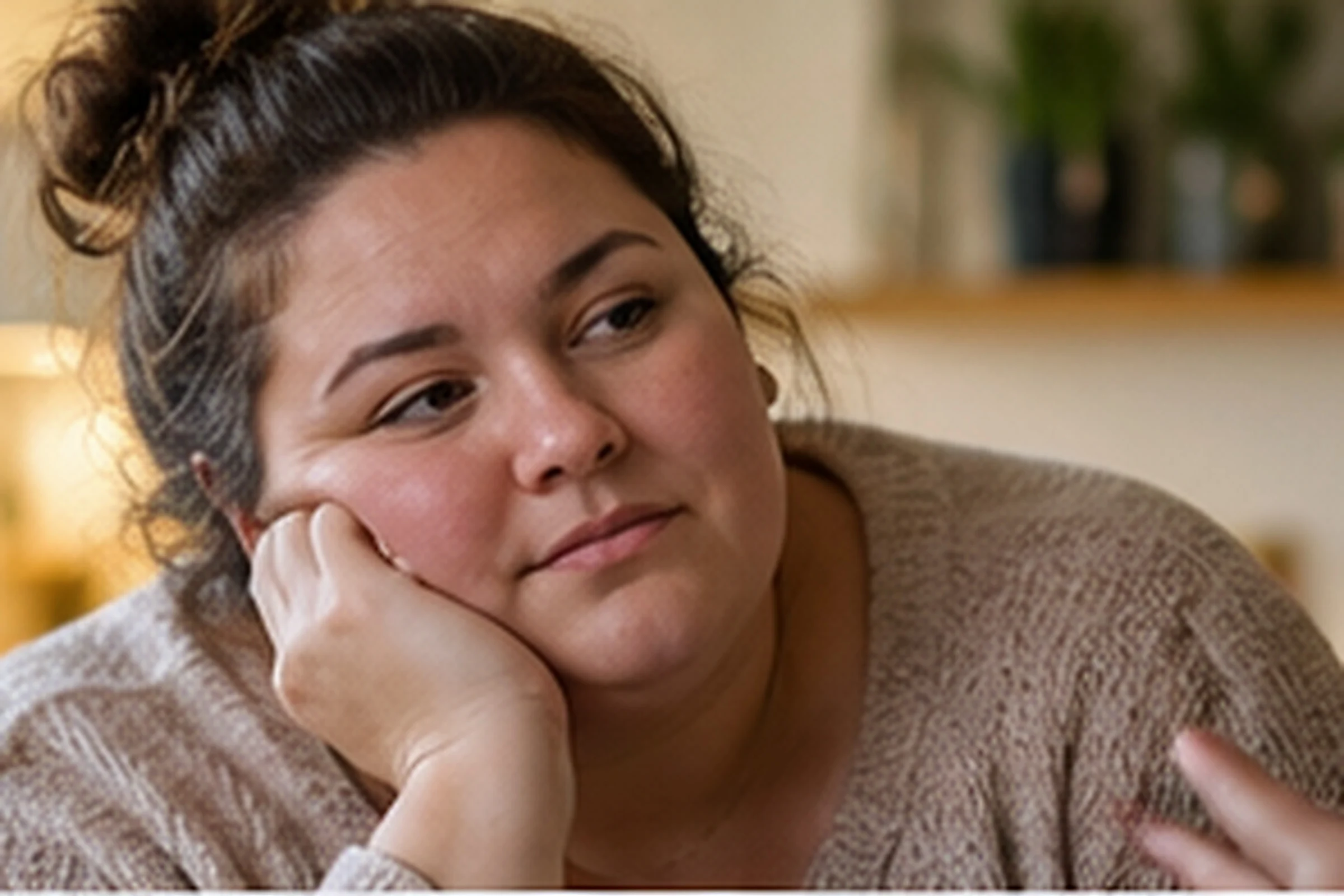
It is almost never shouted. That is part of what makes it so effective. It arrives at a kitchen table, in the car, in a reply under a photograph, in the tone people use for a difficult truth told for your own good. If you cared about yourself, you’d lose weight. Sometimes the person saying it loves you. Sometimes they have never met you. It lands the same way.
The sentence is built to sound like concern, and it is difficult to argue with concern without appearing ungrateful. So most of us don’t argue. We go quiet, or we laugh it off, or we agree, and then carry it around for years.
I would rather take it apart, because what sounds like one statement is three, fastened together so tightly that they pass for common sense. None of them survives being looked at on its own.
The first claim: that care shows up as a number
Care is something you do. It looks like going to appointments and taking the medication you were prescribed. It looks like sleep, vegetables, walks, stretching a bad back, going to therapy, leaving a job that was making you ill, saying no to things that drain you. All of that is visible to anyone who is actually paying attention, and none of it appears on a set of scales in a way you can read from across a room.
Weight, unlike care, is an outcome, and it has a very long list of inputs: genes, hormones, medicines that list weight gain as a side effect, sleep, stress, pregnancy, menopause, pain that makes movement hard, money, time. The list is longer than anyone who uses the sentence imagines; I went through it in an earlier piece on health and body hatred, and it hasn’t got any shorter.
What is striking is how much the habits themselves matter, whatever the scales say. One American study followed nearly 12,000 adults for an average of about fourteen years and looked at four ordinary habits: eating five or more portions of fruit and vegetables a day, exercising regularly, drinking only moderately and not smoking. People who kept none of them were more than three times as likely to die during the study as those who kept all four — and the benefit of the habits held across weight categories, from normal weight to obese. In other words, a woman who is doing the work of looking after herself is doing it, and it counts, whether or not anyone approves of her shape.
The second claim: that weight simply does what you tell it
The sentence assumes that the only thing standing between a person and a smaller body is the decision to care. Researchers have a word for that assumption, and it isn’t a flattering one.
In 2020, a group of international experts in medicine, science and public health published a joint statement on weight stigma. They concluded that weight bias is rooted in the misconception that body weight is easily controlled by changes to diet and physical activity, and that this belief does not match modern scientific knowledge. Genetics plays a substantial part in where a body settles; the geneticists who study it describe a complex system in which the brain takes a leading role in controlling body weight.
None of this means weight never changes, or that nobody should ever try to change theirs. It means that a stranger looking at your body is looking at the result of a calculation they cannot see, and deciding the only variable is your character.
The third claim: that shame is a useful tool
This is the part people most believe, and the part the evidence most firmly contradicts. The sentence is meant to motivate. The theory is that enough discomfort will eventually tip into action.
Two researchers tested something close to that theory using data on more than 6,000 American adults. Those who reported experiencing weight discrimination at the start of the study were about two and a half times more likely to have developed obesity four years later than those who hadn’t, even after accounting for their starting weight. Among people who already had obesity, those who had faced discrimination were more likely to still have it at follow-up. A study of this kind shows association rather than cause, but it points the opposite way from the one the sentence assumes.
Shame does not send people to the gym. It sends them away from the places where they expect to be judged — the gym among them, and the swimming pool, and the changing room, and, most expensively, the doctor’s surgery. A review of the medical evidence found that patients who perceive stigma from their healthcare providers experience stress, avoid care and trust their doctors less. The consulting room is where this sentence does its most serious damage.
So what is the sentence actually for?
Sometimes it is fear, badly expressed. A mother who watched her own mother become ill. A partner who doesn’t know how to say “I’m frightened of losing you” and says something crueller instead. Those people deserve a better conversation than the one they started, and sometimes they can have it.
Sometimes it is about the speaker’s comfort rather than your health. Your body is making them uneasy, and they would like you to fix their unease. And sometimes it is simply a way of ranking people, dressed in the language of wellbeing so that it can be said out loud.
You do not have to work out which it is in the moment. But it helps to know that the sentence is rarely the neutral observation it pretends to be.
What to say back
It depends on who is speaking, and on how much of yourself you want to spend on them.
- Someone who loves you and is genuinely worried: “If you’re worried about my health, ask me about my health. I have a doctor, and I’m happy to tell you how I actually am.” This separates the worry, which may be real, from the verdict, which isn’t theirs to deliver.
- Someone who says it repeatedly: “I’m not going to discuss my body with you. If it comes up again, I’ll end the conversation.” Then do exactly that, calmly, every time. A boundary only works if it is kept.
- A stranger on the internet: nothing at all. You owe no rebuttal to someone who has decided your worth from a single photograph. Block, delete, carry on with your day.
And then there is the hardest version, which is the one that arrives in your own voice, late at night, sounding exactly like wisdom. That one deserves the same scrutiny as all the others. Ask it those three questions. Is it measuring care, or a number? Does it assume weight obeys willpower? Has shame ever actually made you look after yourself better, or has it mostly made you stop going to things?
The sentence asks you to prove your self-respect on a set of scales. You are entitled to refuse the test. Care has always had better evidence: the appointments kept, the prescription collected, the walk taken on a grey afternoon, the no said at the right moment. You won’t see any of it from across a room, and it has never needed an audience.
Sources
- Matheson EM, King DE, Everett CJ. Healthy lifestyle habits and mortality in overweight and obese individuals. Journal of the American Board of Family Medicine, 2012.
- Rubino F, Puhl RM, Cummings DE, et al. Joint international consensus statement for ending stigma of obesity. Nature Medicine, 2020.
- Loos RJF, Yeo GSH. The genetics of obesity: from discovery to biology. Nature Reviews Genetics, 2022.
- Sutin AR, Terracciano A. Perceived weight discrimination and obesity. PLOS ONE, 2013.
- Phelan SM, Burgess DJ, Yeazel MW, et al. Impact of weight bias and stigma on quality of care and outcomes for patients with obesity. Obesity Reviews, 2015.